A transmission control module can be physically installed in an hour and still leave the vehicle completely undrivable. That catches a lot of owners off guard. TCM programming after replacement is often the step that decides whether the car shifts properly, goes into limp mode, or refuses to communicate with the rest of the vehicle at all.
The reason is simple: on many modern vehicles, the TCM is not just a plug-and-play box. It has to be identified to the vehicle, loaded with the correct software, and in some cases matched to the ECU, immobilizer, valve body, or transmission adaptation data. If that process is skipped or done with the wrong tools, the replacement module may be installed correctly from a hardware standpoint and still fail from a systems standpoint.
Why tcm programming after replacement matters
The TCM controls shift timing, pressure management, solenoid operation, and how the transmission responds to engine load and road speed. When you replace it, you are replacing a controller that works in constant communication with other modules. If the new or used unit does not have the right calibration, coding, or security alignment, the transmission may default to protective behavior.
That behavior can look different depending on the vehicle. Sometimes you get harsh shifting, delayed engagement, gear indicator issues, or a check engine light. Other times the car stays in one gear, will not crank, or shows communication faults that seem unrelated to the transmission. This is why replacing the module without proper programming can create a bigger diagnosis than the original fault.
Programming also matters because not every TCM arrives in the same state. A brand-new OEM module may be blank and require full software installation. A remanufactured unit may need setup and initialization. A used module may carry old vehicle data that has to be erased, re-coded, or matched if the platform even allows it. That last part matters – some vehicles accept used modules with proper procedures, and some do not.
What happens during TCM programming after replacement
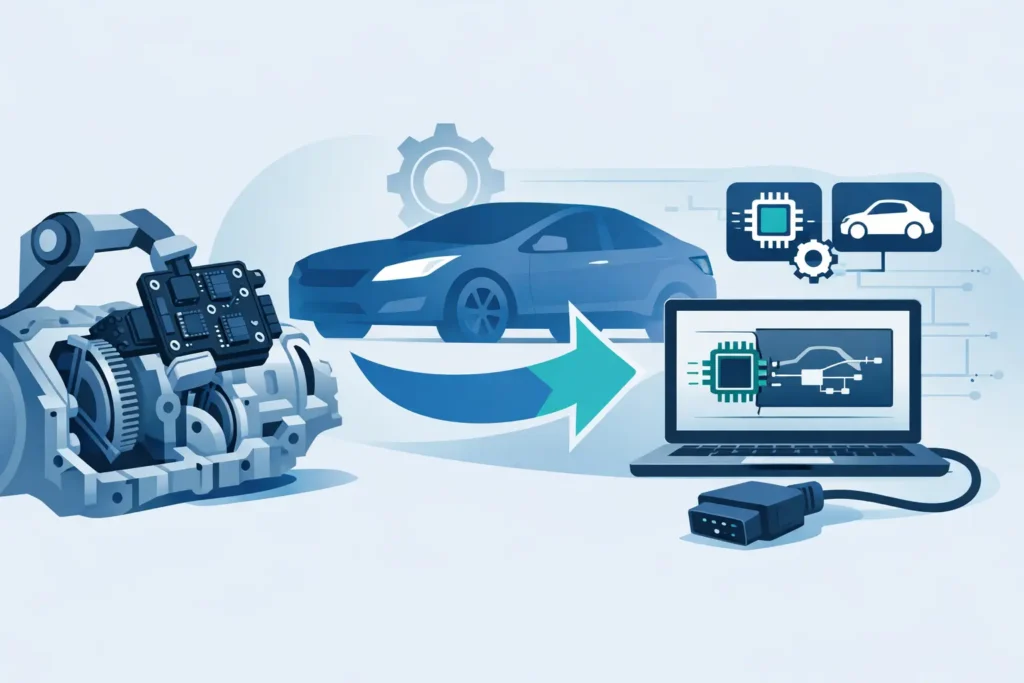
In most cases, programming is more than pressing one button on a scan tool. First, the vehicle has to be identified correctly by year, model, powertrain, and transmission type. That sounds basic, but it is where many failed jobs start, especially on vehicles with mid-year changes or multiple transmission options.
Next comes software loading or module flashing. This updates or installs the operating data that tells the TCM how to function in that exact vehicle. After that, coding or configuration may be required so the module knows which options, final drive settings, and communication parameters apply.
Then there is adaptation. Many transmissions need relearn procedures after module replacement so clutch pressures, shift timing, and driving behavior can be calibrated. Without that step, the vehicle may technically move but shift poorly. Some platforms also require security access or immobilizer-related synchronization before the vehicle will start or before the module will be accepted on the network.
A proper service also includes fault code review before and after programming. If there is wiring damage, low voltage, internal transmission failure, or a CAN communication issue, programming alone will not fix it. The module has to be installed into a healthy enough environment to complete setup.
Signs the replacement TCM still needs programming
A lot of customers call after the module has already been changed by a general repair shop, a used-parts installer, or a do-it-yourself owner. The part is in, but the problem is worse or simply different. That usually points to incomplete setup rather than a bad install.
Common signs include a no-start condition after replacement, the transmission staying in failsafe mode, missing gear display, hard shifts right away, or a scan tool that shows the TCM is not configured. In some vehicles, the speedometer acts strangely or multiple warning lights appear because the network is not getting expected data from the transmission controller.
It can also show up as a communication issue. If the replacement module powers up but does not respond properly, the problem may be incorrect software, unsupported part numbers, or a locked used module. This is where OEM-level diagnostics matter. Generic code readers usually do not go far enough to tell you whether the issue is coding, compatibility, or a deeper electrical fault.
New, used, and rebuilt modules are not equal
This is one of the biggest sources of confusion. Owners are often told that any matching part number will work. Sometimes that is true. Often it is not.
A new module is usually the cleanest option because it is more likely to support full programming and correct initialization. The trade-off is price. A rebuilt module can be a good middle ground if it is prepared correctly, but quality varies between suppliers.
Used modules are where things get complicated. Some can be virginized, re-coded, or adapted to another vehicle. Others are permanently linked to the original car or require bench work before they can be used again. Even when a used TCM is accepted, software level still matters. A physically matching module may have the wrong calibration for your exact setup.
This is why part replacement should never be treated as guesswork. The best result comes from confirming compatibility first, then programming the module with the correct equipment and procedure.
Why DIY tools often hit a wall
There are plenty of scan tools marketed as capable of module programming, but the phrase means different things depending on the tool. Some can clear codes and perform simple resets. Some can run adaptations. Fewer can handle actual software flashing, online coding, or manufacturer security functions.
That gap matters when dealing with a replacement TCM. If the process requires factory server access, stable voltage support, security login, or guided setup functions, a basic aftermarket tool may not complete the job. Worse, interrupted programming can corrupt the module and leave the vehicle in a worse state than before.
Voltage control is another issue. Programming should be done with proper battery support. If system voltage drops during flashing, the module can fail to write correctly. For a vehicle owner already dealing with a disabled car, that is an expensive risk.
When programming is not the only problem
A replaced TCM does not always mean the TCM was the original failure. Sometimes the old module was condemned because of transmission symptoms that were actually caused by power supply issues, fluid contamination, valve body faults, damaged harnesses, or poor network communication.
That is why a real diagnosis still matters even when a module has already been changed. If the replacement unit will not program, or it programs but the symptoms stay the same, the next step is not more guessing. It is checking powers, grounds, network integrity, transmission-related sensors, and whether the internal mechanical condition supports adaptation.
This is also where mobile programming has real value. If the car will not shift into gear or cannot be driven safely, towing it to multiple locations just adds cost and delay. An on-site specialist with OEM-grade diagnostics can determine whether the issue is module setup, compatibility, or a separate fault keeping the system from completing setup.
What a professional mobile service should check
A proper TCM job is part programming and part verification. The service should confirm the replacement module is compatible, assess scan communication, verify battery condition and voltage stability, program or code the module, and complete any required resets or relearns. After that, the vehicle should be checked for fault codes and functional transmission behavior.
If additional issues are present, you should know that before more parts are installed. That saves time and prevents the common cycle of swapping modules, clearing codes, and hoping the next attempt works. For drivers dealing with a no-start, limp mode, or a vehicle stuck at home or at work, that kind of clarity matters as much as the programming itself.
At Car Kez, this type of work is approached the way it should be – as a full electronic systems problem, not just a parts change. The goal is to get you back on the road with the module properly matched, configured, and tested where the vehicle sits.
The practical bottom line
If your transmission control module has been replaced and the vehicle still will not shift correctly, start, or communicate, do not assume the new part is defective right away. TCM programming after replacement is often the missing step, and on many vehicles it is a required one, not an optional extra.
The right programming process can turn a dead-in-the-water repair into a working vehicle. But if the module is wrong, the software is incomplete, or another fault is blocking setup, you need that identified quickly. The best next move is a proper diagnostic approach with the right tools, stable power, and someone who understands how the transmission module fits into the rest of the vehicle electronics. When that happens, the fix gets a lot more straightforward.