A vehicle can have a good battery, a working starter, and plenty of fuel, yet still refuse to start because its electronics are not communicating correctly. A car computer flashing service addresses the software and configuration inside critical control modules, helping resolve no-start conditions, replacement module problems, warning lights, and immobilizer-related faults without automatically sending you to a dealership.
For drivers, the key question is not whether the vehicle has a computer – nearly every modern vehicle does. The question is whether the module needs diagnosis, programming, coding, repair, or a software flash. Those terms are often used interchangeably, but they are not the same job. Getting that distinction right can save time, towing costs, and unnecessary parts replacement.
What a car computer flashing service does
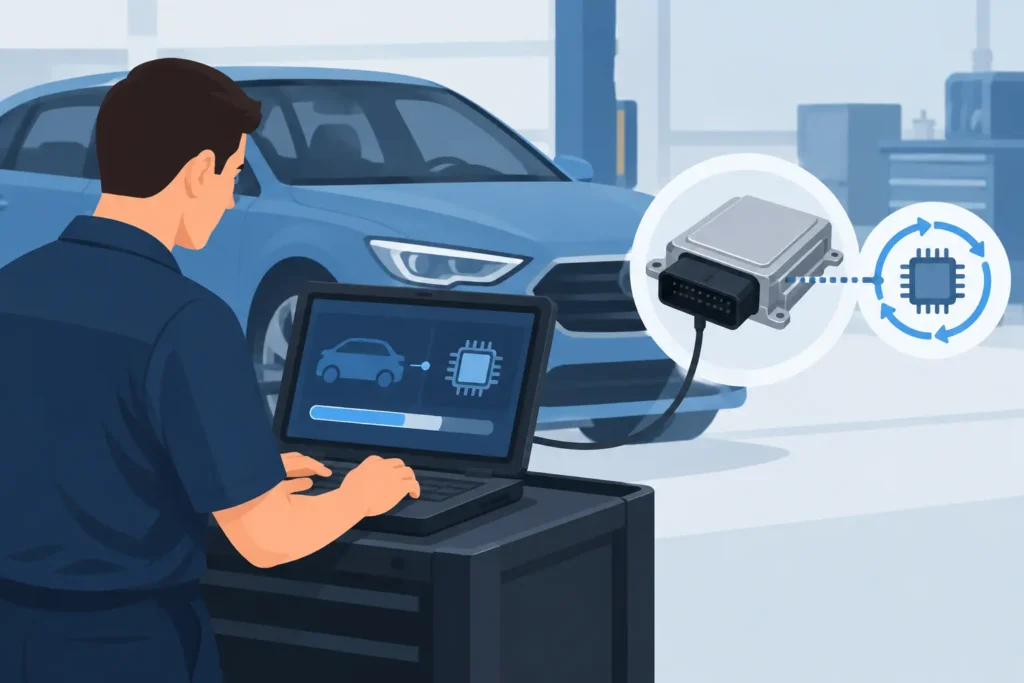
Flashing is the process of writing software or calibrated data to a vehicle control module. Depending on the vehicle and the issue, that may mean installing a manufacturer software update, restoring original data, completing a module replacement, or matching a module to the vehicle’s VIN, immobilizer system, and other onboard computers.
The engine control unit, or ECU, is the module most people associate with flashing. It manages major engine functions such as fuel delivery, ignition timing, sensor interpretation, and emissions-related operation. But the ECU is only one part of the network. A body control module, or BCM, can manage power locks, lights, remote functions, and security features. A transmission control module, or TCM, handles shift strategy and transmission communication.
When one of these modules is replaced, loses data, or stops communicating properly, the vehicle may need more than a simple scan tool reset. It may need the correct software, security access, and programming procedure for that exact year, make, model, and configuration.
Signs your vehicle may need module flashing
A flashing service is not the answer to every warning light or starting issue. Many problems begin with a weak battery, damaged wiring, faulty sensor, failed fuse, or mechanical fault. Proper diagnostics come first.
Still, certain situations point toward programming or module synchronization. A vehicle may crank but not start after an ECU, BCM, ignition switch, or key-related component was replaced. The security or immobilizer light may remain on, even when the key is physically correct. You may see multiple unrelated warning messages, lost communication codes, or functions that stopped working after a module replacement.
Software updates can also be necessary when a manufacturer has released revised calibration to correct a known drivability or module behavior issue. In other cases, a module may be functional but locked to the donor vehicle from which it came. The replacement module must then be prepared and matched correctly before it can work in its new vehicle.
A common example is a car that will not start after an ECU replacement. Installing the part is only the first step. The ECU may need VIN writing, immobilizer synchronization, key programming, and communication checks with the BCM and instrument cluster. Skipping any part of that process can leave the vehicle immobilized.
Flashing, coding, and key programming are different services
These services often work together, particularly on vehicles with electronic anti-theft systems. However, each solves a different part of the problem.
Flashing changes the software or data inside a module. Coding configures available options or vehicle-specific settings, such as installed equipment or regional settings. Key programming teaches the immobilizer which transponder keys or smart keys are authorized to start the vehicle.
For example, replacing a BCM may require coding to match the vehicle’s equipment, flashing to load correct software, and key or security synchronization to restore starting authorization. A basic locksmith may be able to duplicate a key, but complex module matching calls for advanced diagnostic equipment and experience with electronic vehicle networks.
That is why a vehicle that starts after one key is programmed but still has inoperative locks, warning lights, or communication faults needs a broader diagnostic approach. The key may be correct while the vehicle modules are not fully matched.
Why the right equipment matters
Module programming is not a place for guesswork. Modern vehicles use security gateways, encrypted immobilizer data, manufacturer-specific procedures, and sensitive communication networks. An incorrect file, interrupted programming session, or unstable battery voltage can corrupt a module and create a much larger repair.
Professional flashing starts with identifying the module part number, current software level, fault codes, network status, and power supply condition. The technician must confirm whether the module is original, previously used, new, locked, damaged, or simply out of sync with other systems.
Stable voltage is especially important. During a flash, a voltage drop can stop the process before the data is fully written. That can leave the module unable to communicate or prevent the vehicle from starting. A proper service uses appropriate power support and follows a controlled programming sequence rather than rushing through a reset.
OEM-level diagnostics also matter because generic code readers only show part of the picture. They may identify a communication fault, but they often cannot access the programming functions, security information, live data, or guided procedures required to correct it.
Can flashing be done at your location?
In many cases, yes. Mobile programming is especially useful when the car will not start, has no programmed key, or cannot be driven safely to a shop. Instead of arranging a tow and waiting for a service appointment, a qualified field technician can diagnose the vehicle where it is parked and determine whether programming can be completed on-site.
Mobile service is not about treating every job as identical. Some vehicles can be programmed fully at a home, workplace, parking garage, or roadside location. Others may require additional repair first, such as correcting power, ground, wiring, water damage, or CAN network faults. If the module itself has internal hardware damage, flashing alone will not repair it.
Access also matters. The technician needs a safe working area, reasonable access to the vehicle, and enough battery stability to complete the procedure without interruption. For urgent immobilizer or no-start issues across Greater Montreal, bringing diagnostic and programming capability to the vehicle can eliminate a major part of the disruption.
What to expect during a professional flashing appointment
A reliable service begins by confirming the vehicle’s concern rather than assuming the requested repair is the correct repair. The technician will typically verify ownership information, scan all relevant modules, inspect communication faults, and check battery voltage before attempting programming.
If flashing is appropriate, the correct software and configuration are selected for the vehicle. The module may then be updated, restored, cloned where appropriate, or paired with the vehicle’s security system. After programming, the job is not finished until the vehicle is tested. That includes clearing relevant faults, verifying communication, checking starting authorization, and confirming that affected functions operate as expected.
The exact time depends on the vehicle, module, fault condition, and whether a replacement part is involved. A straightforward update may be relatively quick. A no-start vehicle with a replacement ECU, lost keys, security faults, and communication issues takes more diagnosis because several systems must agree before the engine will run.
When flashing is not the right answer
Software cannot repair a broken wire, burned circuit board, failing fuel pump, mechanical engine issue, or low-voltage condition. It also cannot make an incompatible module work simply because the connectors fit. Modules can vary by hardware number, transmission type, engine option, market, and security system.
Be cautious of anyone promising that every no-start vehicle can be fixed with a quick flash. A professional should explain what testing supports the recommendation and what limits may apply. Sometimes the right repair is module programming. Sometimes it is electrical repair, a properly matched replacement module, key programming, or a combination of all three.
Car Kez approaches these cases with mobile locksmith capability and advanced module diagnostics in the same service call. That matters when a starting problem involves both the vehicle’s security system and a control module that needs to be matched correctly.
If your vehicle stopped starting after a module replacement, key issue, battery event, or unexplained electronic fault, avoid repeated jump-starting or swapping parts at random. Preserve the keys you have, keep the battery charged, and have the system diagnosed before the problem turns into a more expensive programming recovery.
Pingback: Does ECU Programming Affect Your Warranty? - Car Kez