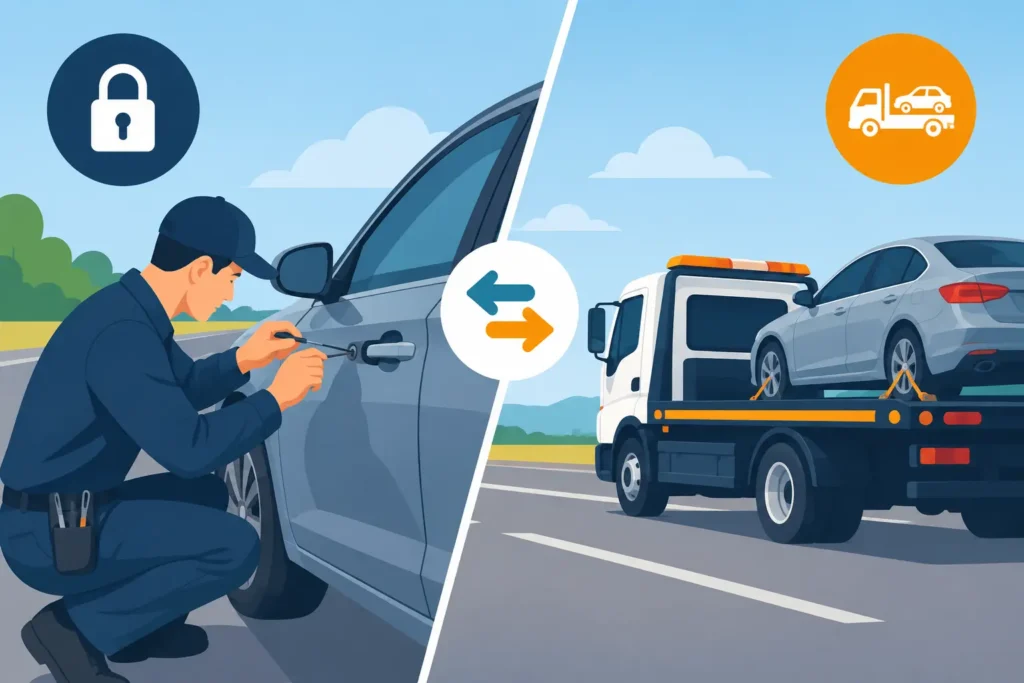
A key breaks in the ignition outside a grocery store. Your smart key disappears after a hockey practice. Your vehicle cranks but will not start after a battery change. In each case, the first question is usually the same: roadside locksmith versus towing – which service gets the vehicle moving with the least delay and expense?
The answer depends on what has actually failed. A tow truck is essential when a vehicle cannot be safely driven or needs mechanical repair at a shop. But when the issue involves access, keys, an immobilizer, or electronic communication between modules, towing may only move the problem somewhere else. A qualified mobile automotive locksmith can often diagnose and resolve it where the vehicle is parked.
Roadside Locksmith Versus Towing: Start With the Symptom
The most useful distinction is simple. Towing transports a vehicle. An automotive locksmith restores access, key function, and, in more complex cases, the electronic authorization needed for the engine to start.
If you are locked out with the keys visible on the seat, you do not need a tow. If every key has been lost, a mobile specialist may be able to cut and program a new key on-site. If the dashboard displays an immobilizer or key warning, the problem may be a damaged transponder, an unprogrammed smart key, a weak vehicle battery affecting module communication, or a fault in the system that recognizes the key. Those are diagnostic and programming problems first, not transportation problems.
A no-start condition deserves more care. A vehicle that will not start does not automatically need to be towed, and it does not automatically need a locksmith. The right service depends on whether the failure is mechanical, electrical, or security-related. A professional roadside assessment prevents the common mistake of ordering a tow before identifying the issue.
Signs a locksmith is the better first call
A mobile automotive locksmith is often the direct solution when you have a lockout, lost, stolen, broken, or water-damaged key, a key that turns but does not start the vehicle, or a remote and smart key that no longer functions correctly. The same applies when a replacement key needs programming, an ignition key has snapped, or an immobilizer is blocking the engine from starting.
Modern vehicles do not treat a key as a simple piece of cut metal. Most use a transponder chip, proximity system, or encrypted electronic credential. The blade may open the door, but the vehicle will not start unless its immobilizer recognizes the key. That is why a basic duplicate from a hardware counter may open the door yet still leave the car immobile.
For vehicles with more advanced faults, the specialist may need to scan for communication errors, verify the condition of the battery and key, and test the relevant control systems. Depending on the vehicle, these can include the body control module, or BCM, engine control unit, or ECU, and transmission control module, or TCM. A mobile technician with OEM-level diagnostic capability can determine whether programming, synchronization, repair planning, or towing is the appropriate next step.
Signs a tow truck is the better first call
Call for towing when the vehicle has a flat tire without a usable spare, accident damage, an overheating engine, a serious fluid leak, brake trouble, steering failure, suspension damage, or a mechanical breakdown that makes driving unsafe. A tow is also sensible when a diagnostic assessment confirms a failed component that cannot be repaired or programmed roadside.
For example, a vehicle with a seized engine, broken timing components, a failed fuel pump requiring shop access, or collision damage needs transport to a repair facility. No responsible locksmith should try to turn a safety-critical mechanical failure into a roadside fix.
Towing may also be necessary when the vehicle is parked in a location where safe on-site work is impossible. A busy traffic lane, restricted garage, severe weather exposure, or inaccessible underground parking can change the plan. The goal is not to avoid towing at all costs. It is to avoid towing when a qualified mobile service can solve the real problem at the vehicle.
Why an Unnecessary Tow Costs More Than the Tow
The cost of a tow is only part of the inconvenience. Once the vehicle reaches a dealership or repair shop, it may wait for intake, diagnosis, authorization, parts, and a technician who can handle key or module programming. If you need a replacement smart key, immobilizer reset, or module synchronization, the vehicle may still require the exact type of service that could have been performed at your location.
There is also a practical issue with modern vehicles: moving a locked or electronically disabled vehicle can be complicated. A vehicle stuck in park, unable to recognize a key, or fitted with electronic steering lock systems may require additional handling before it can even be loaded safely. That can add time and cost without bringing you closer to a repair.
Mobile service is especially valuable for busy drivers. Instead of arranging a ride, waiting for a tow, and then returning to a shop later, you may be able to have a working key made or an electronic fault identified in the same place where the problem happened. For Greater Montreal drivers, this can make a major difference during a workday, late at night, or when a family vehicle is stranded at home.
The Difference Between a General Locksmith and an Automotive Specialist
Not every locksmith performs advanced automotive work. Basic vehicle entry is one service. Cutting a high-security key, programming a transponder, adding a proximity remote, reading immobilizer data, and addressing BCM or ECU synchronization are different levels of work that require specialized equipment and vehicle-specific knowledge.
A capable automotive specialist should ask focused questions before arriving: the year, make, model, symptoms, number of working keys, warning lights, recent battery work, and whether any control module has been replaced. Those details help determine whether the job is a straightforward key replacement or a deeper electronic issue.
This matters when a vehicle has had an ECU, BCM, TCM, ignition, or instrument cluster replaced. Many modules contain security information that must match other systems before the vehicle will start properly. Installing a used module without correct programming can create a no-start condition, warning lights, or communication faults. In those cases, a tow truck can deliver the vehicle, but it cannot perform the configuration and matching work.
Car Kez brings this combination of mobile key service and advanced programming capability to the job site. That means the first response can be based on diagnosis rather than guesswork, whether the vehicle needs a new key, immobilizer service, module programming, or a tow to mechanical repair.
What to Do Before You Call
Take a minute to observe the vehicle without repeatedly trying to start it. Repeated attempts can drain the battery and sometimes complicate diagnosis. Check whether the doors respond to the remote, whether the dashboard shows a key or immobilizer symbol, and whether the engine cranks normally.
If you have a spare key, try it once. If the spare starts the vehicle, the original key or remote is likely the issue. If neither key works, the concern may be with the vehicle battery, antenna system, immobilizer, or related module communication. Do not force a key in the ignition or pry a door open. Damage to a lock cylinder, weather seal, or door mechanism often costs more than professional entry.
When calling for help, have the vehicle identification number available if possible, along with the exact location and any recent work performed. Mention a recent battery replacement, jump-start, module swap, lost key, water exposure, or accident. These details can quickly point a technician toward the likely cause.
The Right Call Gets You Moving Sooner
Roadside locksmith versus towing is not a contest between two services. It is a decision about the actual fault. If the vehicle is unsafe or mechanically disabled, arrange a tow. If the problem is access, key programming, immobilizer authorization, or module synchronization, call a mobile automotive specialist first.
The best roadside decision is the one that sends the right expertise to the vehicle before you spend time moving it. A proper diagnosis at the curb, driveway, office, or parking lot can turn a frustrating no-start or lost-key situation into a direct path back on the road.