
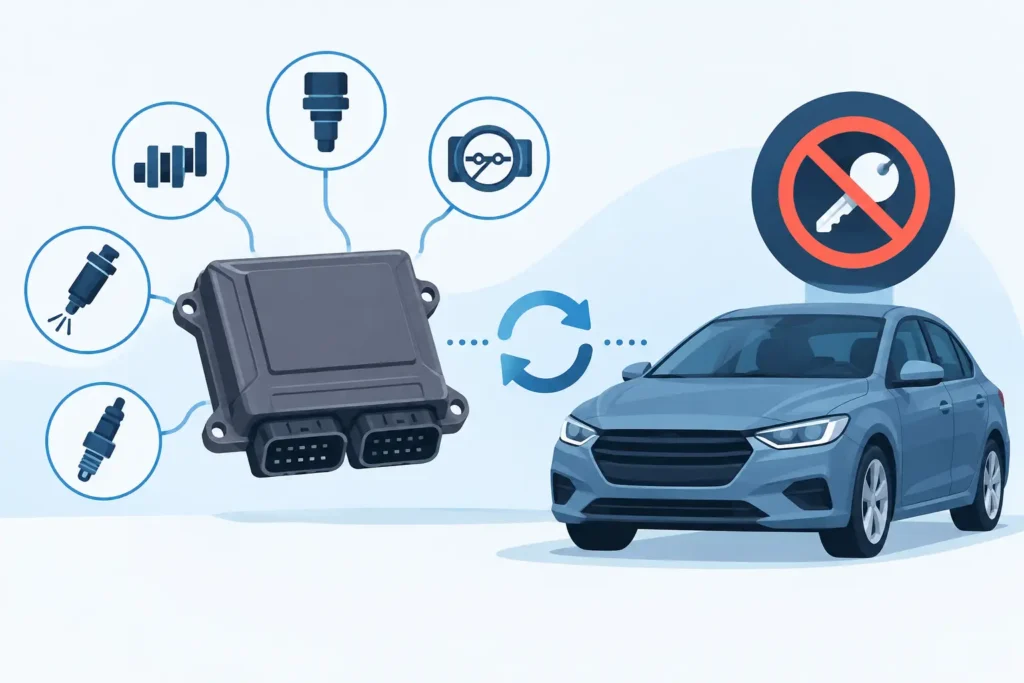
A vehicle can crank normally, have a healthy battery, and still refuse to start because its modules no longer recognize one another. These ECU synchronization examples show why replacing a computer, losing all keys, or repairing collision damage can create a no-start condition that mechanical work alone cannot fix.
What ECU Synchronization Actually Means
The engine control unit, or ECU, does much more than manage fuel and ignition. In many late-model vehicles, it must exchange security data with the body control module (BCM), immobilizer system, instrument cluster, transmission control module (TCM), and programmed keys. Before the engine is permitted to run, those systems check whether the vehicle’s electronic identity matches.
ECU synchronization is the process of restoring that trusted relationship after a module, key, or security-related component has changed. Depending on the make, model, and year, the process may involve immobilizer registration, VIN writing, security access, key programming, configuration transfer, or an online OEM procedure.
That distinction matters because “programming the ECU” is not always one task. A vehicle may need a replacement module configured correctly, but it may also need its keys paired again or its BCM and ECU aligned. The correct repair depends on what changed and what the diagnostic data shows.
ECU Synchronization Examples in Real Repairs
A replacement ECU causes an immediate no-start
One of the most common cases happens after an engine computer fails or is replaced with a used unit. The replacement ECU may physically fit, have the same part number, and communicate with a scan tool, but the engine will not start. The immobilizer sees a mismatch between the ECU and the rest of the vehicle’s security network.
On some vehicles, the replacement unit can be programmed with the vehicle identification number and synchronized through an OEM-level security routine. On others, the original ECU’s data must be transferred to the donor unit before installation. If the original module is badly damaged, the process can be more involved because the security information may no longer be recoverable.
A used ECU is not automatically a bargain. It can reduce parts cost, but compatibility, software version, prior vehicle data, and the condition of the donor unit all matter. A professional diagnosis should happen before a customer spends money on a module that cannot be configured for their vehicle.
The car starts, then stalls after a few seconds
A start-and-stall pattern often points toward immobilizer authorization. The engine may fire because fuel and spark are available, then shut down when the security system fails to validate the key or ECU. A security indicator on the dash may also flash or remain illuminated.
This can happen after an ECU replacement, but it can also occur after a weak battery event, water intrusion, wiring repair, or incorrect key programming. The symptom is similar, yet the repair may be completely different. Reading fault codes and live security data helps determine whether the issue is a key, antenna, BCM, ECU, power supply, or network communication problem.
All keys are lost and the vehicle will not recognize a new key
Modern keys are electronic credentials, not just cut pieces of metal. When every working key is lost, a new key must be cut and programmed into the vehicle’s immobilizer system. On many models, that work also requires security access and a verification process before keys can be added.
In a straightforward all-keys-lost situation, the ECU itself may not need replacement or repair. However, key programming is still part of the same authorization chain. If the BCM, immobilizer, and ECU do not see the new key as valid, the vehicle may unlock but not start.
This is why a basic key copy service is not enough for many newer vehicles. The correct transponder or smart key, accurate key cutting, and OEM-capable programming equipment all need to work together.
A BCM replacement creates key and starting problems
The BCM controls many body functions, including locks, lights, remote entry, and, on many vehicles, part of the immobilizer system. After a BCM replacement, a customer may notice that the remote no longer works, warning messages appear, or the engine will not start even though the key turns normally.
The replacement BCM may require configuration for the vehicle’s options, VIN, and security data. It may also need to learn the keys or complete a theft-deterrent relearn with the ECU. Skipping those steps can leave the vehicle partially functional but not drivable.
This scenario is especially common after water damage or electrical faults. Replacing the visible damaged module is only the first part of the repair. The new module must be introduced correctly to the vehicle network.
Engine and transmission modules no longer agree
An ECU and TCM are separate controllers, but they constantly share information. After a transmission module replacement, programming error, or network fault, a vehicle may enter limp mode, show gear selection errors, or refuse to crank in park or neutral.
Not every TCM issue is an immobilizer issue. Still, certain vehicles require module setup, VIN synchronization, or calibration programming before normal operation returns. A technician needs to separate a genuine synchronization issue from low voltage, connector damage, failed communication wiring, or an internal module fault.
Collision repairs interrupt module communication
After a collision, the ECU may be perfectly healthy while the vehicle still will not start. Damaged wiring, blown fuses, moisture in connectors, or a disturbed ground can prevent the ECU from communicating with the BCM, immobilizer, or gateway module. A scan tool may show multiple communication codes, which can look alarming.
In this case, programming a module before checking power, ground, and network integrity can waste time and money. Synchronization only works when the involved controllers can communicate reliably. Proper diagnosis begins with the vehicle’s electrical foundation, then confirms whether configuration or security pairing is actually needed.
Why Generic Scanners Often Fall Short
A code reader can identify many engine faults, but it may not access the protected functions required for ECU synchronization. Security procedures can require manufacturer-specific software, stable battery voltage, authorized access, correct module files, and a precise programming sequence.
There is also a real risk in guessing. Interrupting a programming session, installing mismatched software, or attempting repeated unauthorized relearns can leave a module unusable or create additional faults. The safest approach is to identify the module part number, verify compatibility, test the vehicle network, and use the proper procedure for that platform.
For drivers, the practical takeaway is simple: a “no-start after module replacement” is not a reason to keep buying parts. It is a reason to confirm what the vehicle’s security and communication systems are reporting.
When Mobile ECU Synchronization Makes Sense
A vehicle that will not start cannot always be driven to a shop, and towing it to a dealership may add cost and delay. Mobile service is especially useful for all-keys-lost cases, immobilizer faults, ECU or BCM replacement work, and roadside no-start diagnosis when the vehicle can be safely accessed.
Car Kez brings OEM-level diagnostic capability to eligible jobs across Greater Montreal, allowing technicians to assess the key, ECU, BCM, and related security systems where the vehicle is located. Some repairs still depend on vehicle condition, module availability, or manufacturer online access, but an on-site assessment can quickly establish the right path instead of relying on assumptions.
Before programming begins, expect a professional to verify ownership, inspect battery voltage and connections, scan all relevant modules, and confirm the exact vehicle configuration. Those steps protect the vehicle and prevent a programming procedure from being applied to the wrong problem.
The Right Fix Starts With the Right Diagnosis
ECU synchronization is rarely about pressing one reset button. It is controlled electronic matching between systems that protect your vehicle from unauthorized starting. The best outcome comes from treating the no-start symptom as evidence, not a diagnosis.
If your vehicle stopped starting after a key loss, module replacement, electrical repair, or collision, keep the original modules and all available keys. They can contain information that makes the repair faster, less expensive, and far more likely to get you back on the road without unnecessary parts replacement.