
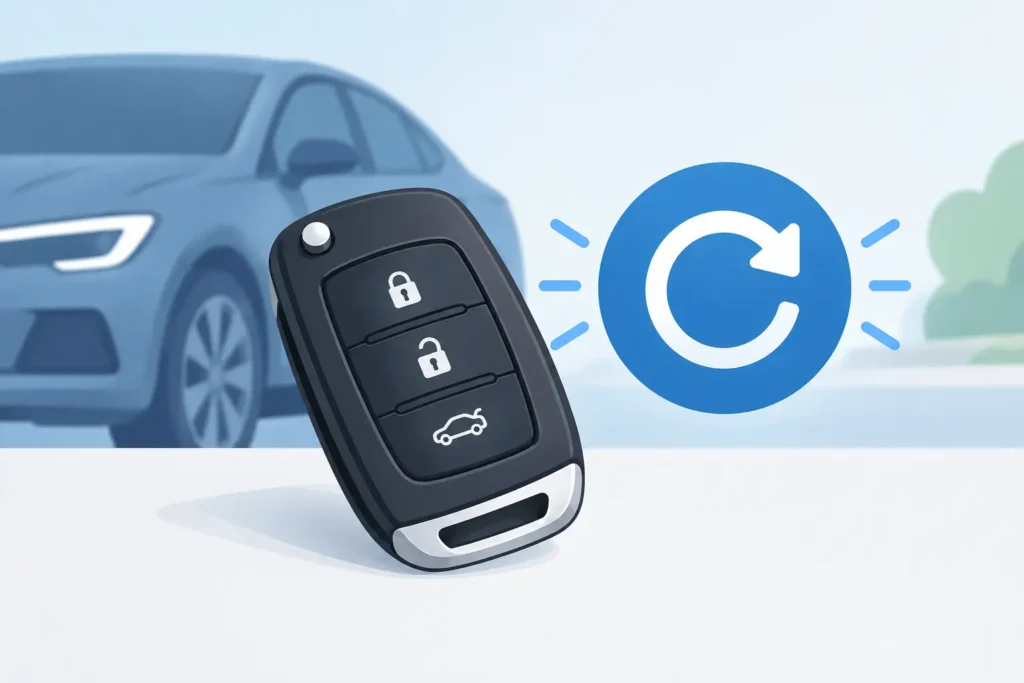
A remote that suddenly stops locking your doors can feel like a major vehicle problem, especially when you are rushing to work, picking up family, or parked away from home. If you searched “comment réinitialiser télécommande automobile,” the good news is that many remote-control issues start with a weak battery, poor contact, or a lost synchronization – not a failed vehicle computer.
That said, a key fob is not just a convenience device. On many late-model vehicles, it communicates with the body control module (BCM), immobilizer system, and smart-key antennas. Resetting the buttons may restore lock and unlock functions, but it will not always fix a no-start condition. The correct solution depends on what the vehicle is doing.
How to reset an automotive remote control safely
Start with the simplest checks before attempting any reset procedure. Stand close to the vehicle and press the lock button several times. Watch for the parking lights, listen for door-lock movement, and try every button on the fob. If only one function fails, such as trunk release, the issue may be the button or the vehicle actuator rather than the remote’s programming.
Next, replace the fob battery with the exact type specified inside the remote or in the owner’s manual. A battery can still power a small indicator light while being too weak to transmit a reliable signal. Use a fresh, quality battery, confirm the positive and negative orientation, and make sure the metal contacts are clean and firmly touching the battery.
After installing the battery, hold a button for a few seconds while standing near the vehicle. Some remotes reconnect automatically once power is restored. If yours does not, remove the battery again for about a minute, press and hold a button for 10 to 15 seconds to discharge residual power, then reinstall the battery. This can reset the remote itself, but it does not erase or reprogram its vehicle security data.
When a battery reset is enough
A simple battery reset is most likely to work when the remote was working normally before the battery became weak or died. It can also help after the fob was dropped, provided the circuit board and buttons were not damaged.
Look closely at the remote case before assuming it needs programming. A cracked housing can let moisture reach the circuit board. Worn rubber buttons may no longer press the tiny switches underneath. Corrosion around the battery terminals can interrupt power. In these cases, replacing the shell, cleaning the contacts, or repairing the circuit board may be more appropriate than resetting the remote.
If you have a spare remote, test it. When the spare works and the main fob does not, the issue is usually isolated to the original remote. When neither remote works, the vehicle-side system deserves more attention. A blown fuse, a weak vehicle battery, a BCM fault, or an aftermarket remote-start system can affect central locking and remote access.
Re-synchronizing a key fob with the vehicle
Some vehicles use a manual re-synchronization process. Depending on the make, model, and year, this may involve turning the ignition on and off in a specific sequence, pressing a certain fob button, or using the mechanical key in the driver’s door. These procedures are not universal. Using the wrong sequence will usually do nothing, but repeated attempts can waste time and create confusion about the real fault.
Use the exact procedure for your vehicle from the owner’s manual or manufacturer service information. Older vehicles are more likely to support manual remote synchronization. Many newer vehicles require a scan tool with security access to add, erase, or synchronize remotes.
There is an important difference between remote synchronization and key programming:
- Remote synchronization restores lock, unlock, panic, or trunk functions.
- Transponder key programming allows the immobilizer to recognize the key and permit engine starting.
- Smart key programming can involve proximity access, push-button start authorization, and module-level security data.
- Module matching may be required after replacing a BCM, ECU, ignition module, or other security-related component.
A remote can unlock the car while still failing to start it. The reverse can also happen: the emergency key or transponder may start the vehicle while the remote buttons do not work. Treat these as separate symptoms until they are properly diagnosed.
If the car will not start
If the remote stopped working and the vehicle now displays a key warning, immobilizer light, or “No Key Detected” message, do not assume a battery reset will solve it. Try holding the fob against the designated backup start location. On some push-button-start vehicles, this is near the start button, steering column, center console, or cup holder. The exact location varies by manufacturer.
If the vehicle starts this way, the fob battery may be weak, or the remote may have a reduced transmission range. If it still does not start, the vehicle may not be reading the transponder or smart-key chip. This can result from fob damage, programming loss, antenna problems, a low vehicle battery, or an issue within the immobilizer or BCM.
Avoid repeatedly trying to start the vehicle with a questionable key. Continuous attempts can drain the vehicle battery and make diagnosis less clear. A technician can verify whether the key is transmitting, whether the car sees the key, and whether the security system is authorizing the start request.
Why a universal reset method does not exist
Automotive remote systems vary widely. A basic early-2000s remote may use fixed button programming, while a newer smart key uses encrypted communication and rolling security codes. Luxury vehicles, European models, and many late-model domestic vehicles can require online authorization, OEM-level diagnostic equipment, or access to security data stored in multiple modules.
This is why generic online instructions can be misleading. A procedure that works for one trim level may not work for another, even within the same model year. It may also add a remote while accidentally removing an existing key from memory if the vehicle’s programming mode is misunderstood.
The trade-off is straightforward: a manual reset is worth trying when the problem clearly began with a dead fob battery and the vehicle otherwise works normally. Professional programming is the safer route when the key is lost, the vehicle will not start, all remotes have stopped working, or a control module was replaced.
When to call a mobile automotive key specialist
You need professional help when a new or replacement remote must be programmed, the fob has been damaged by water, the immobilizer warning remains on, or the vehicle will not recognize a smart key. You should also call a specialist if you have only one working key. Waiting until the last key fails or disappears can turn a simple duplicate into a more involved all-keys-lost service.
For drivers in Greater Montreal, Car Kez can bring key-cutting, transponder programming, smart-key programming, and OEM-level diagnostics to the vehicle. Mobile service is particularly useful when the car cannot be started or when towing it to a dealership would add time and expense.
A proper diagnosis should confirm the condition of the fob battery, remote signal, transponder response, vehicle battery, antennas, BCM communication, and immobilizer authorization. That approach prevents replacing a key when the real problem is in the vehicle, or repairing a module when the remote simply needs a battery and synchronization.
Before replacing your remote, keep the original fob, bring every working key to the appointment, and note any dashboard messages. Those details help identify whether you need a remote reset, key programming, or deeper electronic diagnosis – and get you back on the road with the right fix the first time.