
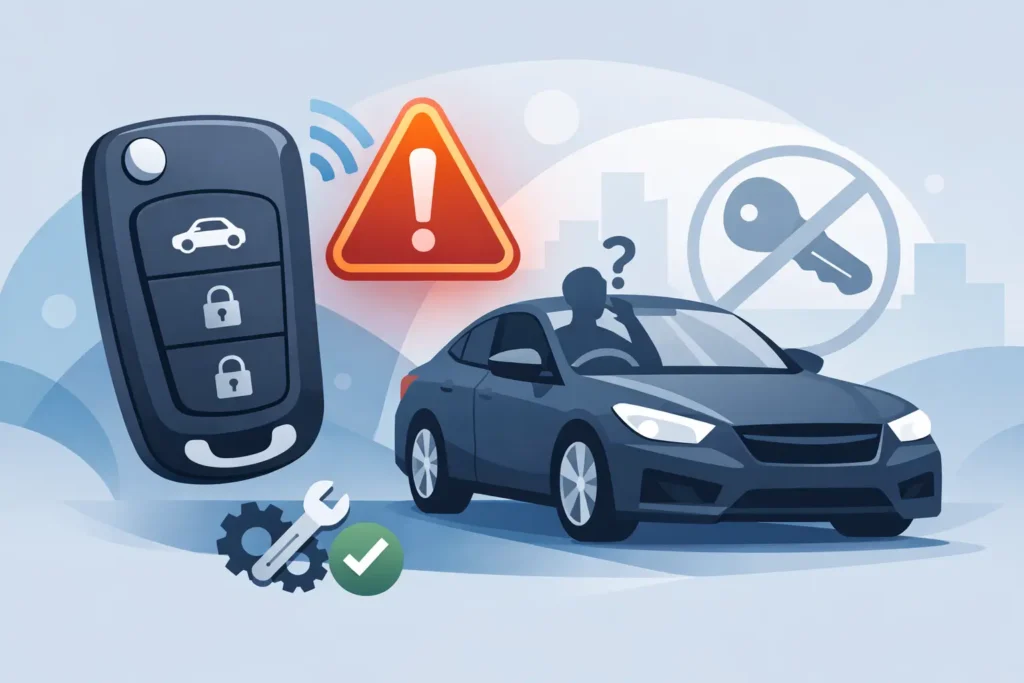
A “No Key,” “Key Not Detected,” or similar warning can stop a perfectly normal day in seconds. If you are asking, why does my car say no key, the vehicle is usually not recognizing the electronic identity inside your key fob. The doors may still unlock, but the immobilizer system will not authorize the engine to start until it sees a valid programmed key.
This is not always a dead key fob battery. Modern vehicles depend on communication between the smart key, antenna system, body control module (BCM), immobilizer, and sometimes the engine control unit (ECU). A fault anywhere in that chain can produce the same message. The right fix depends on what the vehicle is doing before, during, and after the warning appears.
Why Does My Car Say No Key?
A push-button-start vehicle constantly looks for a nearby authorized key. The fob sends a low-power radio signal, and antennas inside the cabin confirm that the key is present. The vehicle then checks the key’s encrypted transponder data before allowing the ignition to turn on.
When that communication fails, the car displays a no-key message. On many models, the engine will not crank. On others, it may crank but fail to start because the immobilizer remains active. If the warning appears while the engine is already running, the car will often keep running, but you may not be able to restart it once it is shut off.
A traditional metal key with a chip can cause a related issue. In that case, the dashboard may show a security light or immobilizer warning instead of “No Key.” The principle is the same: the vehicle cannot validate the transponder chip.
The Most Common Causes
A weak or dead key fob battery
This is the first thing most drivers suspect, and sometimes it is the answer. A weak coin-cell battery can reduce the fob’s signal strength enough that the car only detects it when it is very close to the start button or steering column. You may notice that remote lock and unlock functions have become inconsistent as well.
However, a new battery is not a guaranteed repair. If the fob was dropped, exposed to moisture, or has internal circuit damage, it can still fail with a fresh battery installed. Battery orientation also matters. A battery placed upside down will not power the fob correctly.
The key is in the wrong place
Smart-key antennas have limited coverage. A key buried under metal objects, placed in a crowded bag, or sitting near certain electronic devices may not be detected reliably. Some vehicles have a specific emergency detection point, commonly near the start button, center console, steering column, or a marked location in the cup holder.
Try holding the fob directly against or immediately beside the start button while pressing the brake and starting the vehicle. Check the owner’s manual for the exact emergency-start location for your model. This bypass method does not fix the underlying issue, but it can confirm that the fob battery or signal range is part of the problem.
Radio interference
The key fob and vehicle communicate using radio frequency signals. Strong interference can interrupt that conversation, especially in parking garages, near security systems, radio equipment, or certain charging and electronic installations.
If your vehicle starts normally after moving a short distance away, interference is possible. If it fails everywhere, the cause is more likely the key, vehicle antenna, wiring, or programming.
A damaged, unprogrammed, or erased key
Not every replacement key is ready to start your vehicle. The blade may be cut correctly, and the remote buttons may work, while the transponder or smart-key data has not been programmed to the immobilizer. This is common with online replacement fobs, used keys, and keys copied without proper vehicle-specific programming.
A key can also lose synchronization after a failed programming attempt, water damage, an internal fob fault, or, less commonly, an electrical event. Used smart keys are particularly unpredictable because many are locked to their original vehicle and cannot simply be added to another car.
A vehicle battery or electrical problem
The no-key message can appear when the problem is not the key at all. A weak 12-volt vehicle battery, poor battery connection, blown fuse, corroded ground, or voltage drop can prevent the BCM, receiver, or immobilizer system from operating correctly.
Pay attention to other symptoms. Dim interior lights, slow cranking, multiple warning lights, a clicking sound, or an intermittent no-start condition point toward a broader electrical issue. Replacing the key fob battery will not solve a low vehicle battery or unstable power supply.
Faulty key antennas, receiver, BCM, or immobilizer components
Your vehicle contains antennas that detect the smart key inside the cabin. It may also use a receiver module, keyless entry module, steering-column antenna, and BCM to process the signal. A damaged antenna, loose connector, water intrusion, rodent-damaged wiring, or module fault can stop recognition of an otherwise good key.
This is where diagnosis matters. A warning message alone cannot identify a failed antenna versus a lost key programming record. OEM-level diagnostic equipment can read fault codes, test module communication, check key authorization status, and identify whether the BCM or ECU is seeing the key at all.
Quick Checks You Can Safely Try
Before arranging service, start with the simple checks that do not risk damaging the vehicle. Make sure the fob is inside the cabin, not in the trunk or outside a door. Remove it from a bag or metal case, and hold it at the emergency-start location while attempting to start.
If you have a spare key, test it. This is one of the fastest ways to narrow down the problem. If the spare starts the car, the original fob likely has a battery, internal hardware, or programming issue. If neither key works, the vehicle-side system or vehicle battery deserves closer attention.
Replace the fob battery with the exact specified type, installed in the correct direction. Inspect the fob for loose buttons, a cracked case, corrosion, or signs that it has been wet. Then check whether the vehicle battery terminals are clean and secure.
Avoid repeatedly forcing the start button, disconnecting modules at random, or following generic online programming videos. Many current vehicles require secure access, a stable power supply, and professional diagnostic equipment. A failed attempt can leave the car with no recognized keys or create additional module communication faults.
When a No-Key Warning Needs Professional Service
Call a qualified automotive key and electronic diagnostics specialist when the vehicle will not start with either key, the warning continues after a battery replacement, the key was lost or damaged, or the car has had module or battery-related electrical work.
Professional service is especially useful after replacing a BCM, ECU, ignition component, or keyless entry module. These systems may need synchronization or programming before the car will authorize a start. In some vehicles, the ECU, BCM, immobilizer, and key data must match as a set. Installing a used module without proper programming can trigger a no-key message, security warning, or crank-no-start condition.
A proper on-site assessment should verify the fob battery and signal, scan the relevant modules for faults, confirm vehicle battery voltage, test key recognition, and determine whether key programming, antenna repair, wiring repair, or module matching is needed. This avoids paying for a new fob when the real issue is a receiver or BCM fault.
For drivers facing a no-start situation, a mobile specialist can often eliminate the need for a tow. Car Kez provides on-site key cutting, transponder and smart-key programming, immobilizer diagnostics, and advanced ECU, BCM, and TCM programming across Greater Montreal. That matters when a basic locksmith can open the door but cannot diagnose why the vehicle will not authorize the engine to start.
Can You Drive With a No-Key Message?
If the engine is already running, many vehicles can be driven normally despite a no-key warning. Still, treat it as a time-sensitive problem. Do not shut the car off in a place where you could be stranded until you have a working key or know the issue is resolved.
The risk is highest when the message is intermittent. The car may start five times and then fail on the sixth attempt. If the fob has been unreliable, replace its battery, keep the spare key available, and schedule diagnosis before the issue becomes a roadside emergency.
A no-key warning is your vehicle telling you that the security system has lost confidence in the key communication. Start with the battery and emergency-start location, but do not overlook the vehicle electronics if the issue persists. The right diagnosis gets you back on the road without guessing at expensive parts.