
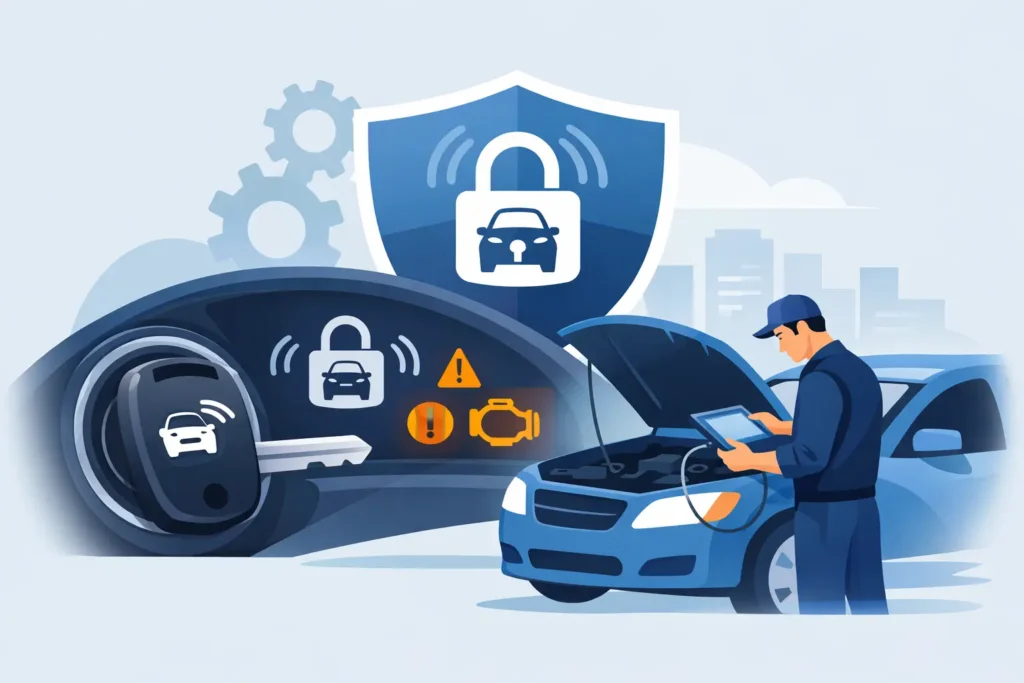
Your car unlocks, the dash lights up, and then nothing – no crank, no start, or a security light that stays on. If you are searching for how to fix immobilizer issue problems, the key point is simple: the vehicle is usually not recognizing the key, the anti-theft system has lost synchronization, or a related control module is not communicating correctly.
Modern immobilizer systems are designed to stop theft, but when they fail, they can leave the owner stranded just as effectively. Some cases are minor, like a weak key fob battery or a damaged transponder chip. Others involve ECU, BCM, or ignition data that now needs proper diagnostics and programming. The difference matters, because the wrong fix wastes time and can make the problem harder to trace.
What an immobilizer issue actually means
An immobilizer is an electronic security system that allows the engine to start only when the correct key or smart key is detected. In most vehicles, the transponder in the key sends a coded signal to the car. The immobilizer control function, often managed through the ECU, BCM, or another module depending on the make, verifies that code before permitting fuel injection, ignition, or starter operation.
When that handshake fails, the symptoms can vary. Sometimes the engine cranks but will not start. Sometimes it starts for a second and shuts off. In other cases, the starter is disabled entirely. A flashing security light, key warning message, or “key not detected” alert often points in the right direction, but not always. Low voltage, wiring faults, antenna ring problems, and module replacement issues can all trigger similar symptoms.
How to fix immobilizer issue symptoms without guessing
The fastest way to handle this is to separate simple checks from problems that require programming. Start with what can be ruled out safely at the vehicle.
If you have a spare key, try it first. This is one of the most useful tests because it immediately helps narrow the issue. If the spare key starts the vehicle, the problem is likely with the original key, its transponder, or its internal battery in the case of a proximity fob. If neither key works, the fault is more likely in the vehicle side of the system.
Next, check the vehicle battery condition. Immobilizer systems are sensitive to voltage. A weak battery can create false communication faults, random warning lights, or a no-start that looks like a key issue. If the battery is drained or unstable, charging or replacing it may restore normal operation. That said, battery replacement can also trigger relearn needs on some models, so the fix is not always as straightforward as it sounds.
Pay attention to the dashboard behavior. A rapidly flashing security icon usually means the key was not accepted. A message about key detection may suggest a dead smart key battery, interference, or an antenna issue. If the car recently had electrical work, a jump start, module replacement, accident repair, or water exposure, that history matters. Immobilizer failures often show up after another repair, not out of nowhere.
Common causes behind immobilizer faults
A damaged or unprogrammed key is near the top of the list. Transponder keys can fail internally, and smart keys can lose function after impact, water intrusion, or poor aftermarket replacement. Not every copied key is properly programmed, and some low-cost duplicates only handle remote functions without matching the immobilizer correctly.
The antenna coil or key reader around the ignition switch can also fail. When that happens, the car cannot read the key even if the key itself is good. On push-to-start vehicles, the issue may involve the start button area, interior antennas, or a failing smart key control unit.
Another common source is module mismatch. If the ECU, BCM, ignition module, steering lock module, or instrument cluster has been replaced, the immobilizer data may no longer match across the system. The car then treats valid components like unauthorized ones. This is why used module installation often leads to a no-start unless the vehicle is properly adapted and programmed with OEM-level diagnostics.
Wiring and communication faults are less common than key issues, but they do happen. Corrosion, rodent damage, collision repair faults, or water intrusion can interrupt CAN communication and create immobilizer-related symptoms. In those cases, key replacement alone will not solve anything.
When a reset works and when it does not
Drivers often search for a reset procedure because some vehicles can recover after a battery reconnect, a manual lock cycle, or a timed ignition relearn. In limited cases, that works. If the system glitched because of low voltage or a temporary communication error, a reset may clear the condition.
But immobilizer systems are not like a frozen phone. If the key is not programmed, the transponder is bad, or the ECU and BCM are out of sync, a reset will not restore authorization. In some models, repeated reset attempts can also trigger lockout periods that slow down proper diagnosis. That is why guessing can cost more time than the repair itself.
How professionals diagnose an immobilizer no-start
Proper diagnosis starts by reading the right modules, not just pulling generic engine codes. A basic scan tool may miss immobilizer data completely. OEM-level or equivalent diagnostic equipment is used to check whether the key is being detected, whether authorization is granted, and which module is rejecting the start request.
This matters because two identical no-start complaints can have completely different causes. One vehicle may need a new programmed key. Another may have a BCM that lost synchronization with the ECU. A third may show an antenna fault or steering lock issue. The symptom is the same, but the repair path is not.
A technician will usually verify battery voltage, check for network communication faults, test available keys, inspect immobilizer-related live data, and confirm whether modules are original, replaced, or previously programmed incorrectly. That process is what separates a real fix from trial and error.
Repairs that actually solve the problem
If the fault is key-related, the repair may involve cutting and programming a new transponder key or smart key, then confirming the immobilizer accepts it consistently. If all keys are lost or corrupted, the vehicle may need all keys erased and new ones enrolled.
If the issue is in the reader or antenna system, that component may need replacement and testing. If a module has been changed, the fix often requires adaptation, coding, or immobilizer data matching between the ECU, BCM, cluster, or other security-related modules. On certain vehicles, that can also involve PIN code access, EEPROM work, or dealer-level programming routines.
This is where mobile electronic specialists have a clear advantage over basic locksmith service. A standard key copy does not solve a module synchronization fault. On the other hand, towing a vehicle for a fix that can be handled on-site is often unnecessary. Car Kez handles these cases with mobile diagnostics and programming, bringing the workshop to you when the issue is more than just a bad key.
What not to do when your immobilizer blocks a start
Avoid replacing random parts based on forum guesses. Swapping the ECU, BCM, ignition switch, or steering lock without confirming the fault often creates a bigger programming job. The same goes for buying a cheap online key and assuming any locksmith can make it work.
Be cautious with repeated jump starts and battery disconnects if the car is showing multiple electronic faults. Low voltage can be the cause, but unstable voltage can also make module communication worse. If the vehicle was recently repaired after an accident, flood exposure, or theft attempt, mention that immediately during diagnosis. It often changes where the problem is found.
When to call for specialist help
If you have tried a spare key, confirmed the vehicle battery is healthy, and the security light or no-start remains, it is time for proper testing. The same applies if a module was recently replaced, all keys stopped working, or the vehicle starts and dies right away. These are signs that the problem is deeper than a weak fob battery.
An immobilizer issue is one of those problems where convenience and technical depth need to come together. You want the car fixed where it sits, but you also need someone who can work beyond simple lock and key service. That means diagnostics, programming, and knowing how the ECU, BCM, and security system interact on your specific vehicle.
If your car is refusing to start because the anti-theft system is not recognizing what it should, the goal is not just to clear a warning light. The goal is to restore correct authorization, verify reliable starting, and get you back on the road without unnecessary parts, towing, or dealership delays.
Pingback: Vehicle Lockout Help That Gets You Moving - Car Kez