
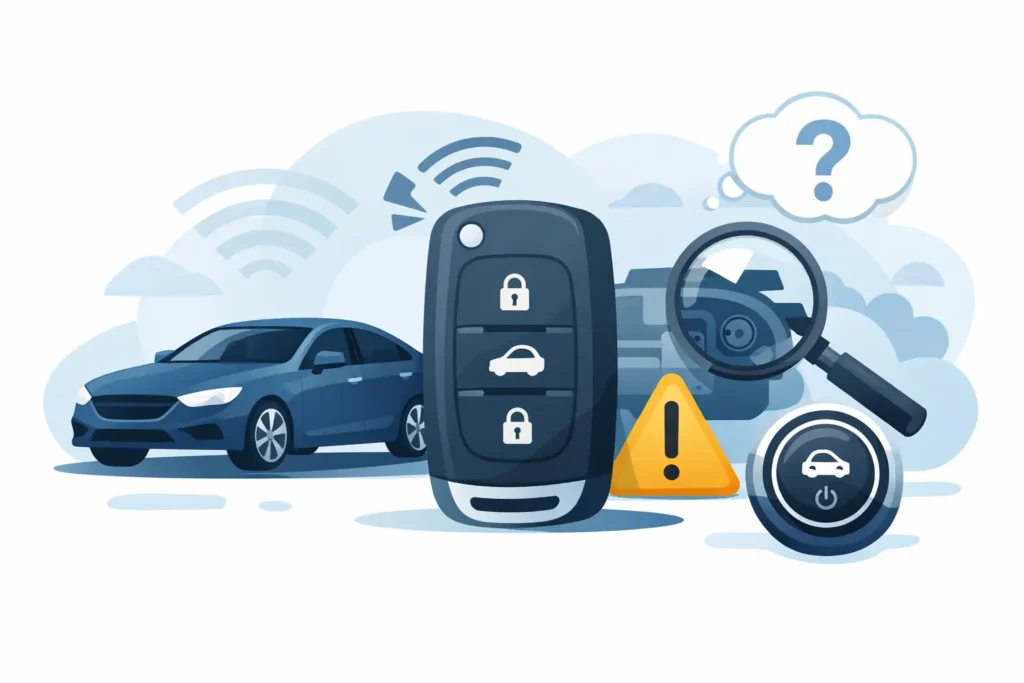
You walk up to the car, press the button, and nothing happens. Or worse, the dash lights up with a warning and the engine will not start. If you are looking for a smart key not detected fix, the first thing to know is this problem is not always the key itself. In many cases, the issue sits somewhere between the key battery, the vehicle antenna system, and the immobilizer or body control electronics.
That matters because guessing can waste time and money. Replacing a perfectly good key fob will not help if the real fault is a weak vehicle battery, a damaged push-button start antenna, or a BCM that is no longer reading the key correctly. The right fix starts with narrowing down where communication is failing.
Why the car says smart key not detected
A modern smart key does more than unlock doors. It communicates with the vehicle through short-range radio signals and encrypted immobilizer data. When that chain breaks, the car may still power on partially, unlock inconsistently, or refuse to crank at all.
The most common cause is a weak coin-cell battery inside the key fob. That is the simple version, and it is often true. But not every no-start warning is solved with a battery swap. Keys can lose programming, internal fob circuits can fail, and vehicles can develop faults in the antennas or modules that read and authorize the key.
Some drivers notice the issue only in certain places, like underground parking garages or near strong electronic interference. Others find the message appears after a car battery replacement, water exposure, collision work, or module repair. Those details help point to whether the problem is basic maintenance or an electronic diagnosis job.
Smart key not detected fix: start with the simple checks
Before assuming you need a new key, try the checks that solve the highest percentage of cases.
First, replace the key fob battery with the correct type and install it carefully. A weak battery can still send enough signal to lock or unlock the doors while failing to provide stable communication for starting. That is why partial function does not always mean the key battery is fine.
Next, use your spare key if you have one. If the spare works normally, the issue is likely isolated to the original fob. If both keys fail the same way, the vehicle side becomes more likely.
Check the vehicle battery too. Low system voltage can create all kinds of misleading symptoms, including intermittent key detection, warning messages, and no-start conditions. A car with marginal voltage may not power the keyless entry and immobilizer system correctly even if the lights still come on.
It also helps to hold the key fob directly against the push-start button or in the backup detection spot listed in the owner’s manual. Many vehicles include an emergency RFID or low-range read position for when the fob battery is dying. If the vehicle starts that way, you have confirmed a key communication problem rather than a full immobilizer lockout.
Finally, remove anything that could interfere with the key. A thick metal key organizer, damaged aftermarket remote-start equipment, or another electronic device pressed against the fob can reduce signal performance. This is not the most common cause, but it happens enough to be worth ruling out.
When the problem is the key fob itself
A dead battery is only one failure mode. Smart keys can also develop internal board damage from drops, water, heat, or poor battery contact. Sometimes the buttons still work but the transponder or proximity circuit does not. In that case, the car may unlock remotely yet still display a smart key warning at startup.
Another possibility is key deprogramming or corruption. This can happen after failed programming attempts, module replacement, or certain electrical faults. Some vehicles are especially sensitive after BCM or ECU work because the immobilizer data must match correctly. If that data is out of sync, the key may physically fit the car and even trigger some electronic functions, but the vehicle will not authorize starting.
This is where a proper scan matters. Generic code readers usually do not show the immobilizer status, smart antenna faults, key registration counts, or module communication data needed to confirm what is actually wrong.
When the vehicle is not reading the key
If two known keys fail, focus shifts to the vehicle. The keyless system relies on receiver antennas, wiring, and control modules to detect where the key is and whether it is valid.
A failed interior antenna can make the car think the key is outside the cabin even when it is in your hand. A door handle sensor or exterior antenna fault can prevent passive entry while still allowing start under limited conditions. A BCM fault can stop the authorization process entirely. In some models, an ECU, steering lock module, or push-button start unit can also be part of the chain.
These issues tend to look random to the driver. One day the car starts after a few tries. The next day it does not detect the key at all. Intermittent faults are common because wiring damage, low voltage, and module errors do not always fail in a clean, predictable way.
That is why replacing parts based on symptom alone can get expensive fast. If the real issue is a module synchronization problem, changing batteries and keys will not fix it. If the fault is a damaged antenna, programming another key may do nothing.
A smart key not detected fix after battery or module work
Many no-detect problems show up right after something else was repaired. A car battery replacement can trigger low-voltage faults or reset learned values. Replacing a BCM, ECU, or steering column component may require immobilizer pairing and key re-registration. Even a used replacement module that physically fits may not communicate properly until it is matched to the vehicle.
This is one of the biggest differences between basic locksmith work and advanced diagnostics. Cutting a key is only one part of the job. On newer vehicles, key authorization is tied to multiple electronic modules, and those systems often need OEM-level programming logic to be brought back into alignment.
If the warning started immediately after electrical work, mention that when you call for help. It shortens the path to the real fix.
What professional diagnosis usually looks for
A proper diagnosis does not start with selling a key. It starts with reading the vehicle and testing the key system in context.
An experienced technician will usually verify battery voltage, test both keys, scan for immobilizer and body control faults, and check whether the vehicle is receiving a key presence signal. From there, the next step may involve antenna testing, module communication checks, key status verification, or programming review.
Sometimes the answer is straightforward: replace the fob battery, program a new smart key, or repair a damaged fob. Other times, the fix is deeper, such as BCM coding, immobilizer synchronization, or tracing a power and ground issue to a failed module circuit.
The trade-off is simple. A quick guess may seem cheaper, but it often leads to repeat service calls and unnecessary parts. A targeted diagnosis costs more upfront than swapping a battery, but it is usually the faster route when the problem is electronic.
Can you fix it yourself or should you call a specialist?
If the issue is limited to a weak fob battery or a spare key solves the problem, a DIY fix may be enough. The same goes for obvious cases like a damaged battery contact inside the fob if you are comfortable opening it carefully.
But if the car still says the key is not detected after a fresh battery, if both keys fail, or if the issue began after module or battery work, it is time for specialist equipment. At that point, the job is no longer about convenience features. It is about immobilizer authorization and electronic communication between security-related modules.
That is also when mobile service becomes especially useful. If the vehicle will not start, towing it just to find out the problem is key programming or BCM-related adds time and cost without solving the root issue any faster. A field technician with the right diagnostic platform can often test, program, and repair on-site. That is the approach Car Kez uses when a driver needs key and module expertise without dealership delays.
The fastest path to the right fix
When you call for service, a few details make diagnosis faster. Say whether the doors still unlock, whether a spare key works, whether the warning is constant or intermittent, and whether any recent battery, collision, or module work was done. Also mention if the car starts only when the fob is held against the button.
Those clues separate a simple key issue from a vehicle-side fault. They also help determine whether you need a new smart key, reprogramming, antenna diagnosis, or deeper electronic module work.
A smart key system is convenient when it works and frustrating when it does not. The good news is that the warning rarely appears without a reason. Once the failing point is identified, the fix is usually clear and the car can get back on the road without guesswork.
Pingback: Car Wont Start Immobilizer Problem Fixes - Car Kez
Pingback: How to Fix Immobilizer Issue Fast - Car Kez
Pingback: Vehicle Lockout Help That Gets You Moving - Car Kez