You’re standing next to your car with a key that turns, a fob that does nothing, or no working key at all. At that moment, the question is not academic – can a locksmith program car keys, and can they do it where your vehicle is parked? In many cases, yes. But the real answer depends on the vehicle, the type of key, the immobilizer system, and whether the locksmith has the right diagnostic equipment.
Can a locksmith program car keys for any vehicle?
A qualified automotive locksmith can program many car keys, including standard transponder keys, remote head keys, and a large number of smart keys and proximity fobs. That said, not every vehicle is equally straightforward. Some makes and models allow efficient on-site programming, while others have tighter security systems, encrypted data, or module conditions that require deeper diagnostic work.
This is where people often run into confusion. They assume key programming is just about cutting a blade and syncing a remote. On modern vehicles, the key is only part of the equation. The immobilizer, body control module, ECU, and sometimes other vehicle systems all have to recognize that key as authorized. If one part of that chain is out of sync, the car may still not start.
So yes, a locksmith can often program car keys, but the better question is whether you’re calling a general locksmith or an automotive programming specialist.
What key programming actually involves
When people hear “program a car key,” they usually mean one of three things. The first is pairing a remote so the lock and unlock buttons work. The second is programming a transponder chip so the vehicle will start. The third is adding or replacing a smart key that communicates wirelessly with the car.
Those are different jobs, and they do not all use the same process.
A basic remote pairing can be simple on some older vehicles. Transponder programming is more security-sensitive because the chip must be accepted by the immobilizer. Smart key programming is often more advanced and may require secure access, PIN retrieval, EEPROM work, or direct communication with vehicle modules using OEM-level diagnostic tools.
That distinction matters because some providers can duplicate a basic key but cannot resolve a no-start issue caused by module mismatch or immobilizer faults. If your vehicle has lost all keys, had a replaced module, or is showing anti-theft errors, you need more than duplication. You need someone who can diagnose the entire authorization system.
When a locksmith can handle it on-site
Mobile service is one of the biggest advantages of a properly equipped automotive locksmith. If your key is lost, broken, locked in the car, or no longer recognized, on-site programming can save you from towing the vehicle to a dealer.
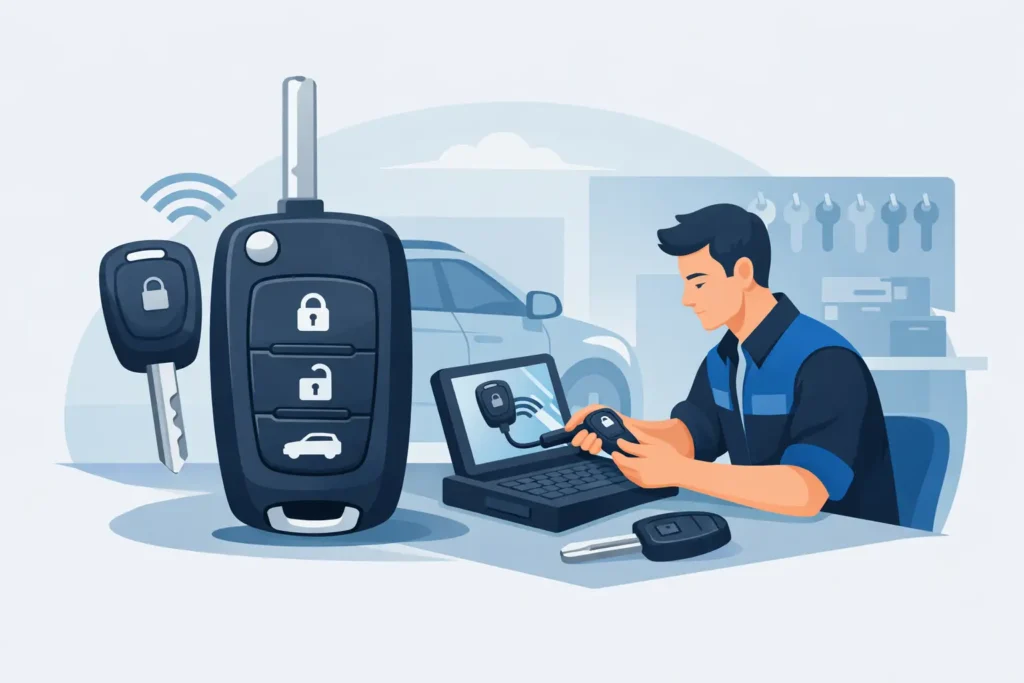
In many situations, a mobile specialist can cut the mechanical key, program the transponder or smart key, test remote functions, and verify that the vehicle starts before leaving. That is especially useful for drivers stuck at home, at work, in a parking garage, or on the roadside.
This on-site approach works best when the locksmith has vehicle-specific software, quality key inventory, and diagnostic tools that can communicate directly with the car’s security systems. Car Kez is built around that model – bringing the workshop to you rather than making you arrange transport for a disabled vehicle.
When the answer is more complicated
There are cases where “yes” comes with conditions.
If the vehicle has an active immobilizer fault, recent theft damage, water intrusion, a dead module, or wiring issues, programming a key may not solve the problem by itself. A key can only be accepted if the supporting systems are functioning correctly. If the BCM, ECU, or related module is offline or not matched properly, key programming becomes part of a larger repair path.
The same applies when a used module has been installed, or when the vehicle has had an ECU, BCM, or TCM replaced. The key may be fine, but the modules may need alignment, coding, or synchronization before the car will authorize start-up.
That is why experienced automotive locksmiths who also handle electronic module programming are in a different category from providers who only cut keys. They can determine whether the issue is the key, the immobilizer, a control unit, or communication failure between modules.
The difference between a locksmith and a dealership
Dealerships can program keys, but that does not always mean they are the most practical option. If all keys are lost and the vehicle cannot move, towing is often required. You may also face scheduling delays, parts ordering, and added downtime.
A capable mobile locksmith offers a different path. The service comes to your location, the diagnosis starts immediately, and many key replacement and programming jobs can be completed without moving the vehicle. For urgent situations, that difference is not minor. It can mean getting back on the road the same day instead of waiting several days.
The trade-off is that not all locksmiths have the same technical range. Some can handle standard transponder keys but not late-model encrypted smart systems. Others can program keys but do not handle module adaptation when something deeper is wrong. That is why equipment and experience matter more than the label “locksmith” by itself.
Can a locksmith program smart keys and push-to-start fobs?
Often, yes. Many modern automotive locksmiths can program proximity keys and push-to-start fobs for a wide range of vehicles. But these systems are usually more sensitive than older transponder setups.
A smart key job may involve secure authentication, emergency start procedures, frequency testing, battery verification, and confirming that the fob is both recognized and fully functional. Some vehicles also limit how keys are added when all originals are missing.
This is another area where there is no one-size-fits-all answer. Some brands are relatively direct. Others have layered anti-theft procedures that demand advanced tools and up-to-date software. If someone quotes smart key programming without first asking your year, make, model, and whether you have a working key, they may be oversimplifying the job.
What to ask before hiring a locksmith for car key programming
If you need a new car key, ask whether the provider works specifically with automotive immobilizer and smart key systems. Ask if they can program keys on-site, whether they support your exact vehicle, and what happens if the issue turns out to be module-related instead of key-related.
It also helps to ask whether they use OEM-level diagnostic equipment or aftermarket tools with advanced programming capability. That does not just affect speed. It affects whether the job can be completed correctly, especially on newer vehicles or more complex systems.
If your car is not starting, be specific. Tell them whether the dash shows a security light, whether the remote still locks the doors, whether any modules have been replaced, and whether all keys are lost. Those details can change the diagnosis before the technician even arrives.
Signs you need more than simple key duplication
A duplicated blade will not fix an immobilizer problem. If the engine cranks but will not start, if the key is suddenly “not detected,” if the anti-theft light stays on, or if a replacement module was installed recently, the vehicle likely needs programming and diagnostics together.
That is where many people lose time and money. They buy a key online, get it cut somewhere locally, and assume the rest is easy. Then the car still will not start because the chip is wrong, the frequency is incorrect, the remote is incompatible, or the immobilizer system has a deeper fault.
A proper automotive locksmith can verify compatibility first, then perform the programming and testing in a way that matches the vehicle’s electronics. That reduces the guesswork and avoids stacking one bad assumption on top of another.
So, can a locksmith program car keys?
Yes – many can, and for a lot of drivers, a mobile automotive locksmith is the fastest and most practical solution. But the quality of that answer depends on the vehicle and the technician. Basic key cutting is one thing. Reliable transponder, smart key, immobilizer, and module programming is another.
If your car key problem is tied to a no-start condition, anti-theft issue, or replaced control module, choose a specialist who can do more than make a copy. The right technician does not just hand you a key. They make sure the vehicle recognizes it, starts correctly, and is ready to move when the job is done.
When you are stranded or pressed for time, that difference matters more than the key itself.
Pingback: Roadside Locksmith Versus Towing – Which One? - Car Kez
Pingback: How to Find Key Code for Your Vehicle Safely - Car Kez