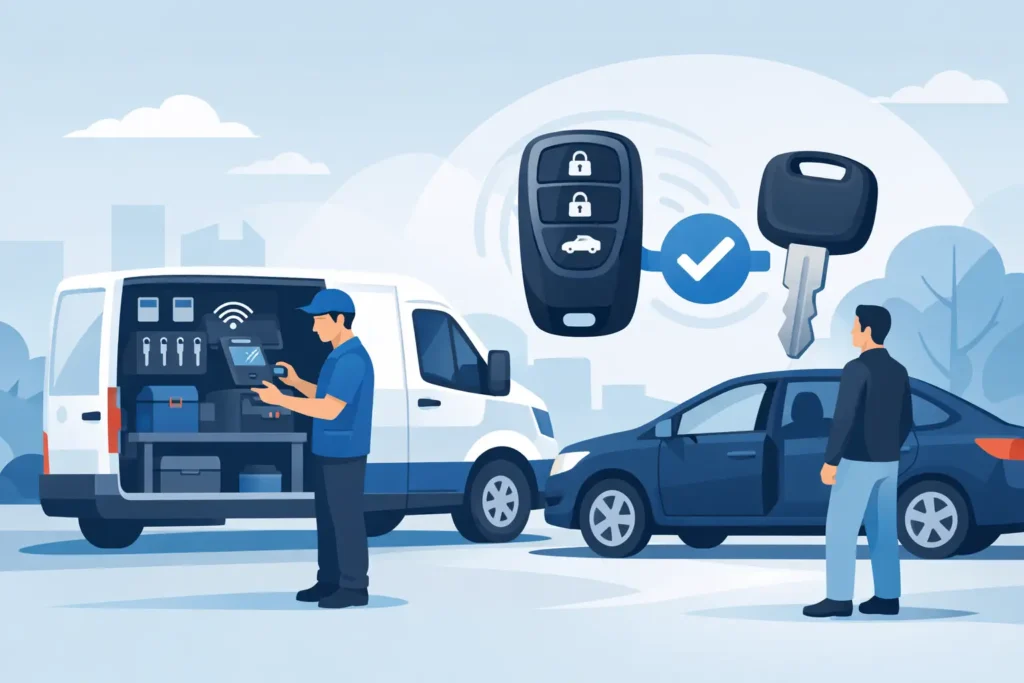
A lost key can turn an ordinary stop into a no-start situation fast. Understanding how mobile car key replacement works helps you know what to expect when a technician comes to your home, workplace, parking garage, or roadside location with the equipment needed to make the vehicle usable again.
For many vehicles, replacement is not simply a matter of cutting metal. Modern keys often contain a transponder chip, remote functions, proximity technology, or a smart key system tied directly to the vehicle’s immobilizer. A properly equipped mobile automotive locksmith can assess the system, create the correct key, program it to the vehicle, and test every required function on-site.
How Mobile Car Key Replacement Works From Call to Start
The process starts with identifying the vehicle and the type of key system it uses. The year, make, model, VIN, and current situation all matter. A conventional metal key, a chipped transponder key, a remote-head key, and a push-button-start smart key require different blanks, programming procedures, and diagnostic tools.
A qualified technician will also verify proof of ownership before producing or programming a key. This protects vehicle owners and keeps the service focused on legitimate access and replacement needs. If the vehicle is locked, the technician can usually gain non-destructive entry first, then continue with key creation and programming.
Once on-site, the technician inspects the vehicle’s locks, ignition or start system, and available electronic modules. If an existing working key is available, it can make certain procedures faster. If every key has been lost, the job may require retrieving key information through the vehicle, reading immobilizer data, or using OEM-level diagnostic procedures to add a new authorized key.
The objective is simple: deliver a key that does more than fit. It must communicate correctly with the vehicle so the engine starts and the access functions work as intended.
Step 1: Identifying the Right Key and Key Blank
The physical key must match the vehicle’s lock and ignition design. For older vehicles, that may mean a traditional blade cut to the correct pattern. For newer vehicles, it may involve a laser-cut or high-security blade paired with a specific transponder or smart-key remote.
Using the wrong blank can lead to a key that looks similar but does not operate the lock correctly. Using an incompatible remote or transponder can leave you with a key that turns but will not start the vehicle. Mobile specialists carry a range of quality key blanks and remotes, but availability depends on the vehicle’s make, year, and system.
Some luxury, late-model, and uncommon vehicles use keys that need to be ordered or require more involved programming. In those cases, a technician should explain the realistic options before work begins rather than promising a one-size-fits-all solution.
Step 2: Cutting the Mechanical Key
After the correct blank is selected, the blade is cut using professional key-cutting equipment. Depending on the vehicle, the technician may decode an existing key, use manufacturer key data, or decode the vehicle’s lock when no key is available.
Precision matters. A poorly cut key can bind in the door lock, wear the ignition cylinder, or fail to turn at all. The technician checks that the new blade operates the door lock and, where applicable, the ignition or emergency key slot before moving on to electronic programming.
For smart keys with an emergency insert, this mechanical step still matters. Even when the vehicle starts with a push button, the emergency blade can be essential if the remote battery dies or electronic access is unavailable.
Step 3: Programming the Transponder, Remote, or Smart Key
This is where mobile car key replacement becomes a specialized electronic service. Most vehicles built over the last several decades use an immobilizer system. The vehicle will only start when it recognizes an authorized transponder chip or smart key.
A technician connects OEM-grade diagnostic equipment to the vehicle’s diagnostic port or communicates with the appropriate immobilizer, body control module, or related system. The new key is then registered to the vehicle. On some models, this is a straightforward procedure. On others, it requires security access, PIN retrieval, module data work, or a specific programming sequence.
Remote functions may be programmed at the same time. These can include lock, unlock, trunk release, panic alarm, remote start, and proximity access. A key that starts the engine but does not operate the doors is not a complete replacement, so each function should be checked before the job is finished.
Why Programming Is Not Always Instant
The time required depends on the vehicle, not just the key. Some models allow a new key to be added within minutes when a working key is present. All-keys-lost situations usually take longer because the vehicle must be accessed and its security system prepared to accept a new credential.
Module condition can also affect the process. A drained battery, water damage, communication fault, aftermarket remote-start system, or prior programming attempt can prevent normal key registration. In these cases, the issue may go beyond the key itself.
When the Problem Is an Immobilizer or Control Module
If a newly cut and programmed key still will not start the vehicle, the technician needs to determine whether the fault is in the key, antenna, immobilizer, ECU, BCM, or another electronic component. Guessing and replacing parts can waste time and money.
OEM-level diagnostics can reveal fault codes, communication problems, and mismatches between modules. For example, an ECU or BCM replacement may need to be synchronized with the vehicle’s immobilizer before it will recognize a key and allow the engine to start. A transmission control module issue can also create confusing no-start or driveability symptoms that are not solved by key replacement alone.
This is one reason to choose a mobile provider with real automotive diagnostic capability, not only basic key duplication equipment. Car Kez brings locksmith tools and advanced programming knowledge to the same appointment, which is valuable when access, starting, and module communication are connected.
Mobile Replacement vs. a Dealership
A dealership can often provide a replacement key, especially for newer vehicles and brand-specific systems. The trade-off is that the vehicle may need to be towed in, appointments can take time, and a lost-key situation can leave you without transportation while you wait.
Mobile replacement is designed to avoid that disruption. The technician comes to the disabled vehicle, performs the work where it sits, and confirms the result before leaving. This is particularly useful for drivers stranded at home, at work, in a shopping center lot, or in a garage where towing is difficult.
That said, mobile service is not automatically the best route in every case. Certain high-security systems, unavailable key stock, manufacturer restrictions, or severe module damage may require dealer involvement or additional parts. A professional technician will be direct about those limits and recommend the most practical path forward.
What to Have Ready Before the Technician Arrives
Having the right information available helps the appointment move faster. Keep your registration, title, insurance document, or other proof of ownership ready, along with photo identification. If possible, provide the VIN and accurate vehicle details when requesting service.
Mention whether you have any existing keys, whether the vehicle is locked, whether it uses push-button start, and whether there have been recent battery, module, or starting problems. Details that seem minor can help the technician arrive prepared with the right key stock and equipment.
If the vehicle is in an underground garage or a tight parking area, describe the access conditions. Mobile programming equipment needs safe access to the vehicle, and clear location details reduce delays during an urgent call.
Final Testing Before You Drive Away
A proper mobile key replacement ends with testing, not just handing over a new remote. The technician should verify mechanical entry, lock and unlock commands, trunk release if equipped, panic function, proximity access, and engine starting. For push-button vehicles, the key should be tested in the normal operating position and through the emergency-start procedure where applicable.
Ask whether old lost keys were removed from the vehicle’s authorized key memory. This can be a sensible security step when you do not know where the original key may have ended up. It is also a good time to ask for a spare key, because programming a second key during the same visit is often easier than dealing with another all-keys-lost emergency later.
When your only key disappears or stops working, the fastest solution is usually the one that addresses both the cut key and the vehicle electronics in the same visit. Keep your vehicle details and proof of ownership accessible, and you will be in a much better position to get back on the road without turning a key problem into a towing problem.