
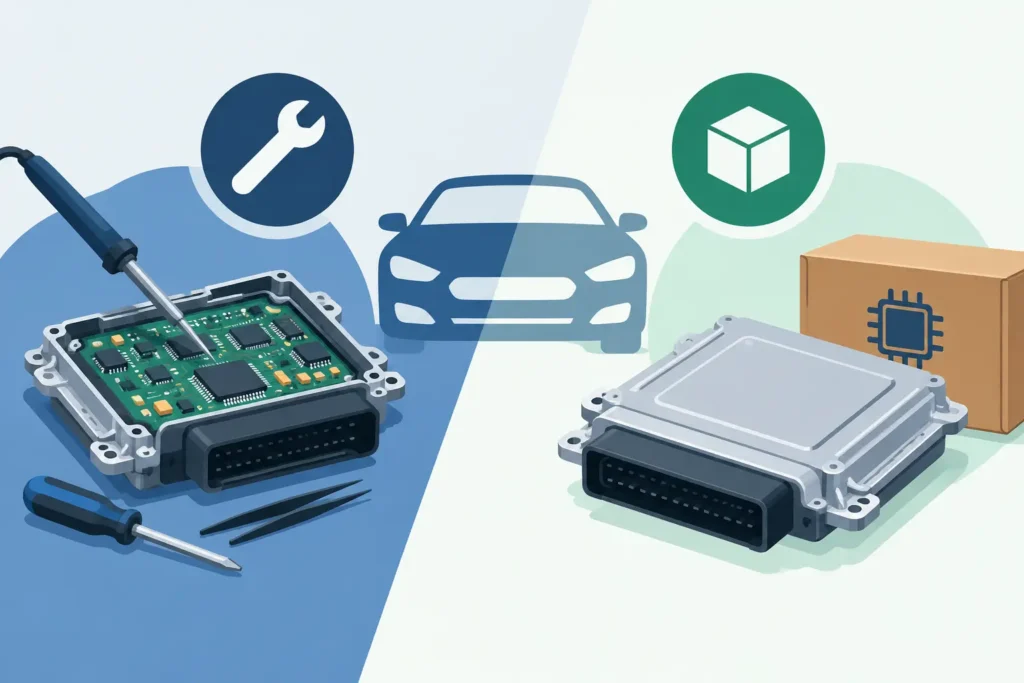
A no-start vehicle with a suspected ECU problem is rarely just an inconvenience. It can leave you stranded, unable to program a new key, or facing a dealership recommendation that sounds expensive before anyone has confirmed the actual fault. ECU repair versus replacement is not a choice to make based on the first warning light or fault code. The right answer comes from accurate diagnostics, the condition of the module, and whether the vehicle’s security system can be matched correctly afterward.
Your engine control unit, commonly called the ECU or ECM, manages critical engine functions such as fuel delivery, ignition timing, sensor inputs, emissions controls, and, on many vehicles, communication with the immobilizer system. When it fails, symptoms can range from intermittent stalling to a complete crank-no-start condition. But those same symptoms can also come from a weak battery, damaged wiring, water intrusion, a bad relay, sensor failures, or a key and immobilizer mismatch.
That is why a proper diagnosis should come before a repair quote.
ECU Repair Versus Replacement Starts With Diagnosis
An ECU is often blamed because it is the computer at the center of the problem. In reality, control units are usually the last component a qualified technician should condemn. Modern vehicles depend on several modules communicating over a network. A fault in the BCM, TCM, immobilizer, ignition switch, wiring harness, or CAN communication circuit can make a healthy ECU appear defective.
A specialist should use OEM-level diagnostic equipment to check whether the ECU powers up, communicates with the scan tool, receives the required voltage and ground, and reports consistent data from connected sensors. Fault codes matter, but codes alone do not prove that the ECU has failed. A communication code, for example, may point to a damaged wire, corroded connector, low system voltage, or another module disrupting the network.
A complete assessment generally looks at these areas:
- Battery condition, charging voltage, fuses, relays, and ECU power and ground circuits
- ECU communication with other vehicle modules and diagnostic equipment
- Wiring, connectors, moisture damage, corrosion, and signs of prior electrical work
- Live sensor data and actuator commands that show whether the ECU is responding correctly
- Immobilizer status, key recognition, and module synchronization when the vehicle will not start
This diagnostic process protects you from replacing a costly module when the root cause is outside the module itself. It also helps prevent a replacement ECU from being damaged by the same electrical issue that caused the original failure.
When ECU Repair Is the Better Option
Repair is often worth considering when the existing ECU is physically intact, communicates reliably, and has a specific internal fault that can be corrected. This can include certain damaged circuits, failed components, corrupt software, or issues caused by limited water exposure that has not destroyed the board or connectors.
Keeping the original ECU can have a major advantage: it may retain the vehicle-specific data already stored inside it. Depending on the make and model, that can include immobilizer information, VIN data, injector coding, adaptations, and communication settings. If the original data can be preserved or cloned, the vehicle may need less programming than it would with a completely different unit.
Repair can also make sense when a replacement ECU is difficult to source. Older vehicles, imported models, or units with restricted availability may have few suitable replacements. In those cases, restoring the original module can be faster and more practical than waiting for a compatible part.
However, repair is not automatically the lower-cost choice. A module with severe fire damage, widespread corrosion, multiple failed circuits, or a heavily compromised circuit board may not be reliable after repair. If the ECU has failed because of a major short circuit, the underlying electrical problem must be corrected first. Otherwise, even a repaired unit can fail again.
A professional recommendation should be based on the probability of a lasting fix, not simply on whether repair is technically possible.
When Replacement Makes More Sense
Replacement becomes the stronger option when the original ECU cannot communicate, has extensive internal damage, or cannot be repaired to a dependable standard. It may also be necessary when the correct software cannot be restored or when an internal processor or memory failure prevents data recovery.
The replacement itself is only part of the job. A used ECU is not always plug-and-play, even if it looks identical and carries a matching part number. Many vehicles require the replacement module to be programmed with the correct VIN, software calibration, configuration, and security information. In immobilizer-equipped vehicles, the ECU may need to be matched to the BCM, key system, or other security modules before the engine will start.
This is where a low-cost used module can become expensive. Installing an unmatched ECU may leave the vehicle with warning lights, no start authorization, incorrect options, transmission communication issues, or a key that no longer starts the engine. Some units are locked to the donor vehicle and require cloning, virginizing, or specialized programming before they can be used correctly.
A new OEM module may offer the cleanest path in some situations, particularly when the manufacturer provides current software and the vehicle has no recoverable original data. But new modules can cost more and may still require dealer-level programming. The best route depends on availability, vehicle age, module condition, and whether the original ECU data can be accessed.
The Security System Changes the Decision
For many drivers, the real concern is simple: will the car start after the ECU is repaired or replaced? That question is especially relevant when the vehicle uses a transponder key, smart key, push-button start system, or electronic immobilizer.
The ECU is often part of a security handshake between the key, immobilizer, BCM, and engine management system. If one component is replaced without proper matching, the engine may crank but not start. In other cases, the vehicle may display a key warning light, immobilizer message, or security-related fault code.
This is why ECU work should not be treated as a basic parts swap. The module needs to be checked alongside the vehicle’s access and anti-theft systems. If keys have been lost, the BCM has been replaced, or the car has a history of water damage or jump-start issues, the programming plan may be just as important as the mechanical repair.
A mobile specialist with the right diagnostic and programming equipment can often assess these systems where the vehicle is located. For a disabled vehicle, that can avoid the added cost and delay of towing it to a dealership before anyone has identified the actual issue.
Cost, Downtime, and Long-Term Reliability
There is no universal price comparison between repair and replacement. ECU repair may cost less when the original unit is recoverable and its data can be retained. Replacement may be more economical when repair labor becomes extensive, when a tested compatible unit is readily available, or when the original module is too damaged to trust.
Downtime also matters. A repair may require module removal, bench testing, and specialized electronic work. A replacement may be faster if the correct unit is available, but only if programming, cloning, or immobilizer synchronization can be completed without delays. The quickest option is not always the one with the lowest parts price.
Long-term reliability should carry real weight. If a vehicle has recurring water leaks, corroded connectors, unstable charging voltage, or harness damage, replacing the ECU without correcting those conditions is a temporary fix at best. A sound repair plan addresses both the module and the reason it failed.
What to Ask Before Approving the Work
Before agreeing to ECU repair or replacement, ask what testing confirmed the ECU itself is defective. You should also ask whether power, ground, wiring, and communication circuits were checked; whether the replacement unit will require programming; and whether your keys and immobilizer will be tested after the work is complete.
It is also reasonable to ask whether the original ECU data can be cloned or recovered. Retaining original data can reduce programming complications, although it is not possible on every vehicle or every type of failure. Clear answers here help you compare quotes fairly instead of comparing only the price of the module.
For drivers dealing with a no-start condition, lost key situation, or suspected module failure in Greater Montreal, Car Kez can bring advanced diagnostics and programming capability to the vehicle. The goal is to identify the failed component, complete the required matching procedure, and get you back on the road without unnecessary towing or guesswork.
Before authorizing an ECU, insist on a diagnosis that explains both the electrical fault and the programming plan. The right repair is the one that restores reliable starting, protects the vehicle’s security system, and does not leave an unresolved problem waiting behind the next ignition cycle.