
A car that will not start, a dashboard that lights up without warning, or power locks that stop responding can turn a normal day into a disruption. If you searched comment localiser panne électrique auto, the goal is not to guess which part failed. It is to isolate the circuit, connection, or control module causing the problem without creating a larger one.
Modern vehicles combine high-current electrical systems with networks of electronic modules. A weak battery can look like a bad alternator. A corroded ground can imitate a failed BCM. A key that will not authorize starting can be an immobilizer issue rather than a starter problem. A methodical diagnostic process saves time, parts, and towing costs.
Start by defining the electrical symptom
Before touching a fuse or disconnecting a battery, identify exactly what changed. Does the vehicle have no power at all? Does it crank but not start? Is one feature, such as the radio, power windows, lighting, or door locks, affected? Or do multiple systems fail at once?
The timing matters just as much. An issue that appears after a battery replacement, jump-start, collision repair, water intrusion, key loss, or module replacement points the diagnosis in a specific direction. For example, a no-start condition after installing a replacement ECU may require immobilizer synchronization, not another battery or starter.
Watch for patterns. Headlights dimming while cranking usually points toward battery condition, cable resistance, or a poor ground. An intermittent warning light that appears over bumps may suggest a loose connector, damaged wiring, or moisture in a fuse box. A vehicle that starts with one key but not another may have a transponder or smart-key programming issue.
Check the battery before blaming electronics
A stable power supply is the foundation of every auto electrical diagnosis. Even relatively new batteries can lose charge, develop internal faults, or have loose terminals. Many modules behave unpredictably when voltage drops, and that can generate a long list of misleading trouble codes.
With the engine off, a healthy, fully charged 12-volt battery generally reads around 12.6 volts. A reading near 12.2 volts indicates a partially discharged battery, while a lower reading deserves charging and testing before deeper diagnosis. Voltage alone is not the full story, though. A battery can show acceptable voltage with no load and collapse when the starter draws current.
Inspect both battery terminals for corrosion, loose clamps, damaged cables, and heat marks. Then check the main ground cable where it attaches to the body and engine. A ground connection can look intact but have corrosion between the terminal and metal surface. That hidden resistance can cause slow cranking, random module faults, flickering lights, and communication errors.
If the engine starts, charging voltage should normally rise above battery resting voltage. Exact values vary by vehicle because many late-model charging systems are computer controlled, but consistently low charging output requires alternator, belt, wiring, and control-circuit testing.
Inspect fuses, relays, and visible wiring carefully
A blown fuse is a clue, not a final answer. Replacing it may restore a feature briefly, but it will blow again if there is a short circuit, seized motor, damaged harness, or incorrect accessory installation behind it.
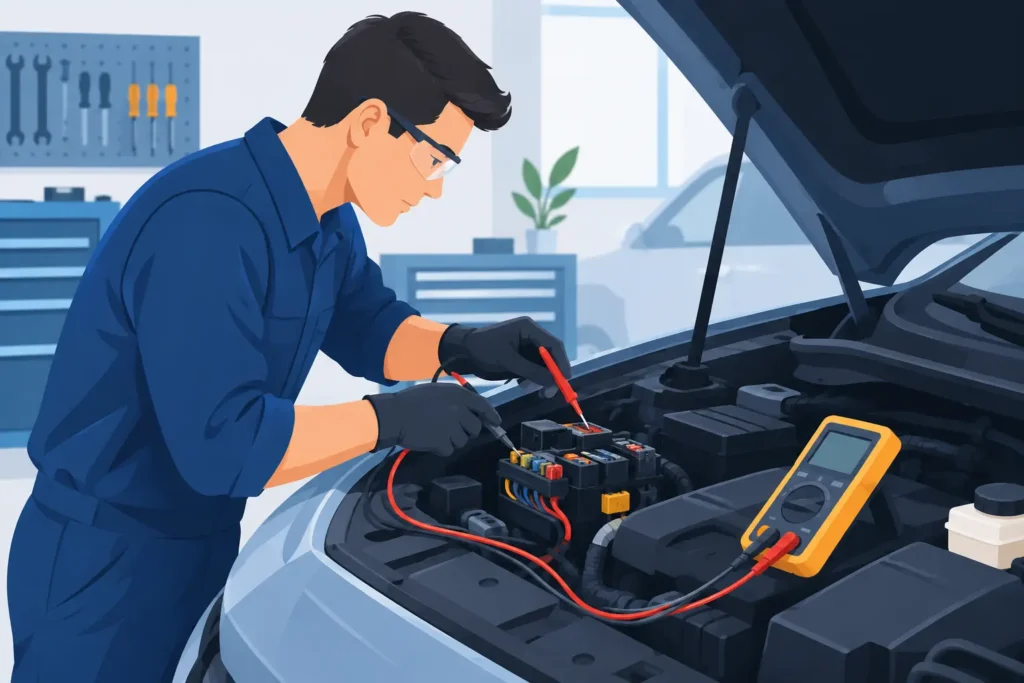
Use the fuse-box diagram to identify the circuit related to the failed system. Inspect the fuse visually, then confirm it with a test light or multimeter. Testing both sides of an installed fuse is often more useful than simply pulling it out, because it confirms whether power is actually reaching the circuit.
Relays deserve similar attention. A relay may click without delivering enough current through its internal contacts. Swapping it with an identical known-good relay can sometimes help narrow the problem, but only when the relays match exactly and the vehicle documentation supports the test.
Look for obvious damage near the battery, underhood fuse box, door hinges, trunk lid, and areas exposed to water. Rodent damage, aftermarket remote starters, trailer wiring, dash-camera installations, and previous collision repairs are common sources of electrical faults. Avoid pulling apart connectors blindly. Modern connector locks are fragile, and improper probing can spread terminals or damage module circuits.
Use voltage-drop testing for cables and grounds
Continuity testing can tell you whether a wire is broken, but it often misses a connection that is technically continuous yet too resistant to carry current. This is where voltage-drop testing is more valuable.
The test is performed while the circuit is operating under load. For a starter complaint, for example, a meter can measure voltage loss across the positive battery cable and then across the ground side while someone attempts to crank the engine. Excessive voltage drop identifies resistance in a cable, terminal, connection, or ground path.
This approach is especially useful when the symptoms are intermittent. A corroded ground may pass a simple continuity test but fail when the blower motor, starter, or rear defroster demands current. The trade-off is that live testing requires experience. An incorrect meter connection around high-current circuits can damage equipment or create a safety risk.
Scan every relevant module, not just the engine computer
A basic code reader may only access engine-related data. That is not enough for many electrical problems. Vehicles often rely on a network of modules, including the ECU or PCM for engine functions, BCM for body electronics, TCM for transmission control, ABS, steering, instrument cluster, keyless-entry, and immobilizer systems.
OEM-level diagnostics can identify modules that are offline, communication faults on the CAN network, low-voltage history, invalid key recognition, configuration mismatches, and trouble codes stored outside the engine computer. A module communication code does not automatically mean the module failed. It may be a wiring problem, poor power or ground, network short, or a weak battery event.
Live data is often the deciding factor. A scan tool can show whether the BCM sees a door as open, whether the immobilizer recognizes the key, whether the brake-switch signal reaches the start authorization system, or whether an ECU receives the correct crank request. That prevents costly guesswork.
Be careful around immobilizers, keys, and replacement modules
When a vehicle has power but will not start, the problem may be electronic authorization rather than a mechanical failure. Common signs include a flashing security light, a start-and-stall condition, a no-crank response with a recognized key issue, or a message indicating that no key is detected.
Do not assume a dead key fob battery is the full explanation. Some push-button vehicles have an emergency backup recognition procedure, while others require proper key programming or diagnosis of the antenna, receiver, BCM, or immobilizer system. Repeatedly attempting to start the vehicle with unprogrammed keys can add confusion to the diagnostic process.
Replacement ECUs, BCMs, and TCMs also need more than physical installation in many vehicles. They may require VIN writing, coding, configuration transfer, security access, and synchronization with other modules. Installing a used module without confirming compatibility can leave the vehicle with warning lights, no-start conditions, or inoperative accessories.
When a parasitic draw is draining the battery
If the battery repeatedly goes dead after the car sits, the issue may be a parasitic draw. Some current draw is normal while modules remain in sleep mode. The concern is a circuit that stays awake or an accessory that continues consuming power after the vehicle should be asleep.
Diagnosis requires measuring current correctly and allowing the vehicle enough time to enter sleep mode. Opening doors, unlocking the car, or connecting equipment can wake modules and distort results. A technician typically isolates the draw by monitoring current while checking fuse circuits and module activity. This is not a good place to start removing fuses at random, especially on vehicles with security systems, memory settings, or sensitive electronics.
Know when to bring in a mobile electrical specialist
Basic checks can reveal loose battery terminals, damaged fuses, and obvious wiring problems. Stop and seek professional diagnosis when you find melted wiring, repeated fuse failures, airbag or ABS faults, CAN communication codes, water intrusion near modules, security-system warnings, or a no-start after module replacement.
Airbag circuits should never be tested with a conventional test light, and module connectors should not be probed without correct wiring information and equipment. These systems can be expensive to repair when a simple diagnostic shortcut goes wrong.
For drivers in Greater Montreal, Car Kez can bring OEM-level diagnostics, key programming, and module synchronization to the vehicle location. That means a disabled vehicle does not always need to be towed before the electrical cause is identified. The right next step is the one that confirms the fault before parts are replaced – and gets you back on the road with confidence.