
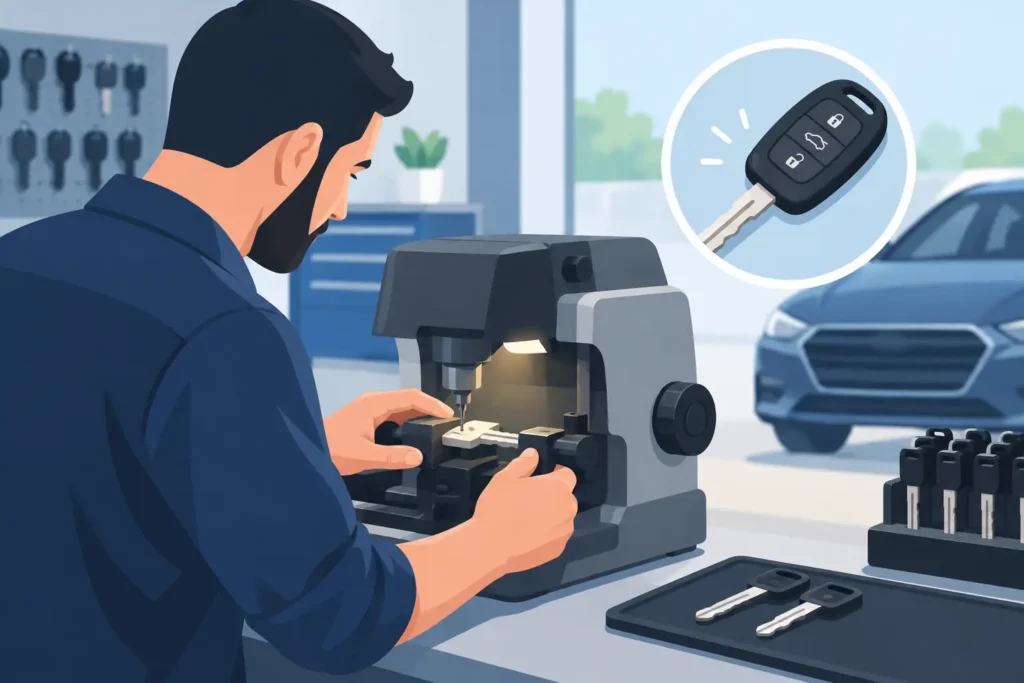
A lost or damaged car key can stop your day fast, especially when the vehicle will not start after you find a replacement. So, can locksmiths cut laser keys? Yes, an equipped automotive locksmith can usually cut them, but cutting the metal blade is only one part of getting you back on the road.
Many modern vehicle keys also need a transponder chip, remote function, or smart-key system programmed to the vehicle. The right technician needs the correct key blank, precision cutting equipment, and diagnostic tools that can communicate with your vehicle’s immobilizer system.
What People Mean by a Laser Key
Despite the name, a laser key is not cut with a laser. Most are high-security sidewinder keys, named for the winding groove cut into the center or both sides of the blade. Unlike an older single-sided key with visible teeth along one edge, a sidewinder key has a thicker, more complex design that requires a dedicated machine to duplicate accurately.
These keys are common on many late-model vehicles because their design is harder to copy with basic equipment. That does not make them impossible to replace outside a dealership. It simply means a general hardware-store key machine or basic locksmith setup is unlikely to be enough.
A capable automotive locksmith can identify the key style, obtain the proper blank, and use a sidewinder or high-security key-cutting machine to create the mechanical blade. The new blade should turn smoothly in the door and ignition, where applicable, before the electronic side of the job begins.
Can Locksmiths Cut Laser Keys and Program Them?
In many cases, yes. A specialized automotive locksmith can cut and program a laser key in one service visit. The answer depends on the vehicle’s make, model, year, key system, and the reason you need the replacement.
For a traditional remote-head key, the technician may need to cut the blade, program the transponder chip that authorizes starting, and pair the remote buttons for locking and unlocking. For a proximity or push-button-start vehicle, there may be no visible blade used for normal operation, but the emergency insert still needs cutting and the smart key must be registered to the vehicle.
The programming process is what separates a key that opens the door from a key that actually starts the engine. Your vehicle’s immobilizer checks for an approved chip or smart key signal. If the key is not correctly programmed, the engine may crank without starting, display a security warning, or refuse to recognize the key at all.
This work requires professional diagnostic equipment and current vehicle coverage. Some systems can be programmed through the diagnostic port. Others require security access, PIN retrieval, an all-keys-lost procedure, or module-level work involving the body control module, engine control unit, or instrument cluster.
When a Basic Locksmith May Not Be the Right Fit
Not every locksmith provides advanced automotive key services. A locksmith who mainly handles residential locks may be able to copy an older metal key, but may not have the machinery or software for a high-security automotive key and immobilizer system.
That distinction matters most when you have lost every working key. With no original key available, the technician may need to generate the key code, read vehicle data, and perform an all-keys-lost programming sequence. This is more involved than cloning a spare from an existing working key.
Some newer vehicles also use encrypted smart-key systems, secure gateways, or manufacturer-specific procedures. In those situations, the locksmith must have OEM-level diagnostic capability and legitimate access to the proper programming process. If a vehicle has had an ECU, BCM, TCM, ignition, or instrument cluster replaced, the issue may not be the key at all. Module synchronization can prevent a correctly cut and programmed key from starting the vehicle.
The Difference Between Cutting, Cloning, and Programming
These terms are often used interchangeably, but they solve different problems.
Cutting creates the metal blade pattern that operates the mechanical lock or emergency ignition. A precise cut matters. A blade that is slightly off can bind, wear the lock, or fail to turn.
Cloning copies information from an existing transponder into a compatible new key. It can be convenient for certain vehicles, but it is not available or advisable for every system. Some vehicles require each key to be individually registered in the immobilizer memory.
Programming adds the new key to the vehicle’s authorized-key system. This is often necessary for remote-head keys and smart keys, particularly when you want all functions to work correctly and the vehicle to recognize the key as a valid starter key.
A professional will choose the method that fits the vehicle rather than treating every replacement key as a simple copy job.
What a Mobile Automotive Locksmith Can Do On-Site
A properly equipped mobile service brings the key-cutting machine, key inventory, battery support, and diagnostic tools to the vehicle. That can save you from arranging a tow, waiting for a dealership appointment, or transporting a vehicle that cannot be started.
For drivers in Greater Montreal, this is especially useful during an all-keys-lost situation, a lockout, or a no-start issue in a driveway, parking garage, or workplace lot. The technician can verify ownership, inspect the vehicle’s key system, cut the correct blade, perform programming, and test the result where the vehicle sits.
At Car Kez, the goal is not simply to hand over a key blank. The job is complete when the key is cut accurately, the security system recognizes it, the vehicle starts as expected, and the remote or proximity functions are tested when applicable.
What You Should Have Ready
Vehicle security procedures are designed to prevent unauthorized key creation, so expect to show identification and proof that you own or are authorized to use the vehicle. A registration document, title, insurance information, or fleet authorization may be requested depending on the situation.
If you still have a working key, keep it available. It can speed up identification, reduce programming complexity, and help confirm that the replacement performs exactly as it should. If you have no keys, provide the vehicle identification number and as much detail as possible about the year, model, trim, ignition type, and whether it uses push-button start.
It also helps to explain the actual symptom. A key that turns but will not start the car, a dash message saying key not detected, and a remote that no longer locks the doors can point to different causes. The problem could be the key battery, damaged key electronics, an immobilizer fault, low vehicle battery voltage, or a module communication issue.
Cost and Timing: What Changes the Job
Laser key replacement costs vary because the key itself is only one variable. A common sidewinder transponder key with an existing original is generally more straightforward than a late-model proximity key with every key lost. The vehicle’s security system, key availability, programming requirements, travel distance, and any module diagnosis all affect the final scope of work.
The same applies to timing. Many key replacements can be handled in a single mobile appointment when the correct key blank and system coverage are available. Certain vehicles may require additional research, security authorization, or more advanced programming steps. A professional locksmith should explain that clearly before proceeding instead of promising a universal fix.
A Cut Key Is Only Useful if the Vehicle Accepts It
The best replacement key is not just one that fits the lock. It is one that gives you reliable access, starts the vehicle, and works with its security system without creating new issues. That requires accurate cutting, correct programming, and a technician who understands when the fault reaches beyond the key itself.
If your laser key is lost, damaged, or no longer recognized, choose an automotive specialist who can diagnose the full system at your location. That approach can turn a frustrating key problem into a tested, working solution without sending your vehicle on a tow truck.