
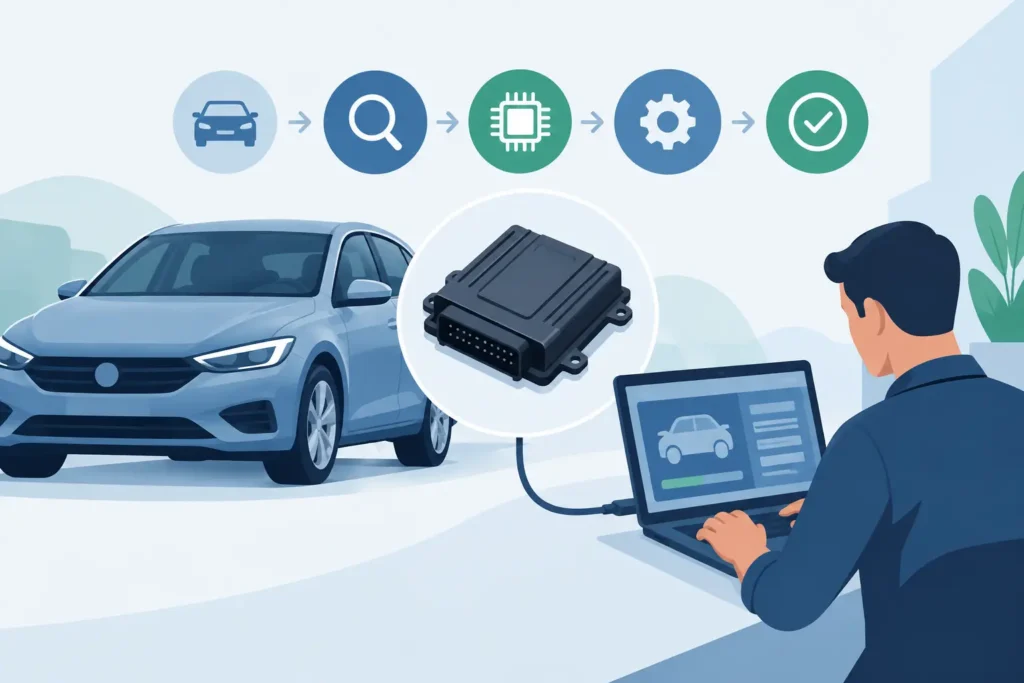
A replacement body control module can look like the answer to a no-start, lighting, locking, or key recognition problem. But installing the part is only half the job. This BCM coding process guide explains what must happen after installation, why the vehicle may still refuse to operate, and when professional module programming is the safer option.
The BCM controls many of the systems drivers use every day: door locks, interior lights, exterior lighting, power windows, alarm functions, remote entry, and, on many vehicles, communication with the immobilizer. When its configuration does not match the vehicle, seemingly unrelated electrical problems can appear at once.
What BCM Coding Actually Means
A body control module is not a universal plug-and-play part. Even when two modules share the same part number, their stored configuration can differ based on trim level, engine, transmission, market, options, and security system. BCM coding is the process of writing or restoring the correct vehicle-specific information so the module can communicate properly with the rest of the network.
Depending on the vehicle, the work may include programming the vehicle identification number, loading factory configuration data, enabling installed options, clearing transport or replacement mode, and matching security information. Key and immobilizer setup may also be required. The exact procedure depends on the manufacturer, model year, and whether the module is new, used, remanufactured, or original.
Coding is often confused with scanning for trouble codes. A diagnostic scan can identify communication faults or configuration errors, but it does not automatically make a replacement BCM compatible. In the same way, clearing a warning light does not correct a module that has the wrong VIN or security data.
When a BCM Needs Coding
The most common situation is BCM replacement after water damage, electrical failure, collision repair, or an internal fault. A vehicle may also require configuration after a module has been updated, cloned, reset, or installed from another vehicle.
Symptoms vary. Some drivers have a vehicle that will not crank or starts and immediately stalls. Others find that remote locks stop responding, headlights behave incorrectly, windows lose their one-touch function, the horn sounds unexpectedly, or a security warning stays on. A BCM issue can resemble a weak battery, bad key, failed fuse, wiring fault, or network problem, which is why diagnosis comes before programming.
A used BCM deserves special caution. It may contain the prior vehicle’s VIN, key data, mileage-related records, or anti-theft information. Some modules can be prepared for reuse; others require a new or properly remanufactured unit. On certain vehicles, a used module cannot be installed successfully without specialized data transfer or security access.
BCM Coding Process Guide: The Professional Workflow
A proper job starts by confirming that the BCM is truly the cause. Replacing modules based on a single fault code can waste time and money. A qualified technician checks power, grounds, fuses, connectors, network communication, and related control units before deciding the module has failed.
1. Verify the vehicle and replacement module
The technician identifies the exact vehicle configuration and confirms the replacement module is correct. Part numbers matter, but so do software versions, option codes, and hardware revisions. A module that fits physically may still be wrong electronically.
The vehicle battery must also be stable. Programming with low voltage can interrupt communication and leave a module partially configured. A professional setup uses a properly maintained power supply rather than relying on a weak battery or a small booster pack.
2. Perform a full pre-scan and preserve data
Before any changes are made, the technician records fault codes and checks which modules are communicating. If the original BCM can still be accessed, its configuration, coding, and key-related information may be recoverable. Saving this data can reduce programming time and preserve vehicle-specific features.
This step also catches problems that coding will not fix, such as damaged wiring, corroded connectors, a failed CAN network connection, or an unrelated immobilizer fault. Programming a new BCM into a vehicle with a network short is a poor trade-off and can create more confusion.
3. Write configuration and vehicle data
With OEM-level diagnostic equipment, the replacement BCM is configured for the vehicle. The procedure can involve VIN writing, factory option programming, software calibration, or an online coding session. Some brands retrieve build data from the manufacturer database. Others require manual selection of equipment options or transfer of information from the original module.
This is where precision matters. Incorrect configuration may cause features to disappear or operate incorrectly. For example, daytime running lights, tire pressure monitoring, keyless entry, rain-sensing wipers, remote start, or power liftgate operation may depend on the BCM’s stored settings.
4. Complete security and key functions
On many modern vehicles, the BCM is part of the anti-theft system. It may need to synchronize with the engine control unit, gateway module, instrument cluster, smart key system, or other security-related components. If this synchronization is incomplete, the vehicle may not recognize the key or authorize starting.
Key programming should be performed only after ownership has been verified and the vehicle’s underlying fault has been assessed. A valid key can still fail to start a vehicle when the immobilizer system, module communication, or BCM security data is not matched correctly.
5. Test every affected function
The final step is more than confirming the engine starts. The technician should test door locks, remote functions, exterior and interior lights, wipers, windows, warning indicators, horn, alarm behavior, and any options tied to the body control system. A post-scan confirms that configuration faults and communication errors have been addressed.
Not every function can be tested from the driver’s seat. A careful final check is what separates a successful module installation from a car that leaves with a new problem waiting to surface.
Why DIY BCM Coding Can Go Wrong
DIY scan tools are useful for reading basic codes and monitoring simple data, but many do not provide the security access, manufacturer subscriptions, programming files, or guided procedures needed for BCM replacement. Online instructions can also be misleading because the same model may use different systems across years and trim levels.
The biggest risk is not simply getting an error message. An interrupted programming session can leave a control unit unresponsive. Incorrect VIN or configuration writing can trigger anti-theft issues, communication faults, or features that no longer work as intended. There is also the possibility that the original issue was never the BCM in the first place.
For some older vehicles, coding can be relatively straightforward. For late-model vehicles with encrypted security gateways, cloud-based authorization, or tightly integrated immobilizer systems, the process is more restricted. It depends on the manufacturer and the exact module involved.
Mobile BCM Programming: When It Makes Sense
A vehicle that will not start is difficult and expensive to transport. Mobile programming can be a practical option when the vehicle is safely accessible, battery power can be supported, and the necessary module and security procedure can be completed on-site.
Car Kez brings advanced diagnostics and module programming support directly to drivers in Greater Montreal, helping avoid a tow when the situation allows. Before scheduling, have the year, make, model, VIN, symptoms, and any module part numbers available. That information helps determine whether on-site BCM coding is appropriate or whether the vehicle needs additional repair first.
A good module programming job does not end with a completed screen message. It ends when the vehicle recognizes its keys, communicates correctly, and performs the functions you depend on before you drive away.
Pingback: Central Locking Repair for Cars That Lasts - Car Kez