A replacement key that fits the ignition but still will not start the vehicle usually points to one thing: car key programming was never completed properly. For many drivers, that is the moment the problem stops feeling like a simple locksmith job and starts looking a lot more electronic. Modern vehicles rely on communication between the key, immobilizer, and control modules, which means cutting a key is only one part of getting you back on the road.
That is why programming matters so much. On older vehicles, a mechanical copy might have been enough. On newer cars, trucks, and SUVs, the key has to be recognized by the vehicle’s security system, and in some cases matched with other modules before the engine will crank or continue running.
What car key programming actually does
Car key programming is the process of pairing a transponder key, remote key, or smart key with the vehicle’s onboard security and control systems. The goal is simple: authorize the right key and block anything else. When that pairing is successful, the vehicle can confirm that the key belongs to it.
In most modern systems, the key contains a chip that communicates with the immobilizer. The immobilizer then works with modules such as the ECU or BCM to allow starting. If the data is missing, corrupted, or mismatched, the vehicle may stay in anti-theft mode, refuse to crank, or start and shut off immediately.
This is also why two vehicles from the same brand may require completely different procedures. The make matters, but so do the model year, trim level, key type, immobilizer generation, and whether any modules have been replaced before.
Why a cut key alone is not enough
A lot of drivers assume the hard part is cutting the metal blade. In reality, the electronic side is often the part that determines whether the job is finished. A perfectly cut key can open the door and turn the ignition, yet still fail because the transponder was not learned to the vehicle.
The same applies to push-to-start systems. A smart key may lock and unlock the doors but still not allow the engine to start if the vehicle does not recognize the key’s programmed credentials. In other cases, the vehicle may detect the key intermittently, which creates a frustrating problem that feels random but usually traces back to weak programming, module sync issues, or a faulty key.
When car key programming is needed
The most obvious situation is lost or stolen keys. If all keys are gone, the vehicle often needs a new key generated and then programmed from scratch. In many cases, existing keys should also be erased from memory so a missing key can no longer start the vehicle.
Programming is also common after buying a spare key. Many aftermarket or replacement keys need to be added to the system before they function correctly. Sometimes the remote buttons work after basic setup, but the starting function still needs a separate immobilizer programming procedure.
Another common case is after module replacement. If the ECU, BCM, ignition switch, or other security-related component has been changed, the key data may no longer match the vehicle. That can create a no-start condition even when the key itself is good. At that point, the issue is not really about the key alone. It is about getting the key and modules to speak the same language again.
What can go wrong during programming
This is where the difference between basic duplication and proper diagnostic work becomes clear. Some vehicles accept a new key quickly through a straightforward add-key procedure. Others require security access, PIN retrieval, EEPROM work, or module adaptation. If the wrong process is used, the result can be a wasted key, a vehicle that still will not start, or in some cases a locked system that takes more time to recover.
Battery voltage is one of the most overlooked issues. Programming with unstable voltage can interrupt communication and cause errors. A weak vehicle battery, a failing push-button ignition system, or an already damaged module can all interfere with the process.
There is also the quality of the replacement key. Not every aftermarket key performs the same way. Some program correctly but have weak signal range. Some work for a short time and then fail. Others are simply incompatible with the exact vehicle configuration, even when they look identical.
Why diagnostics matter as much as the key
A failed start after key replacement is not always a key problem. It may be an immobilizer fault, BCM issue, steering lock fault, ECU communication problem, or damaged antenna ring around the ignition. Without proper diagnostics, it is easy to replace the wrong part or keep reprogramming a key that was never the real issue.
That is why OEM-level scan tools and module access matter. A proper diagnostic approach can confirm whether the vehicle is rejecting the key, losing communication with a control unit, or storing anti-theft faults that point somewhere else. For the customer, that means fewer guesses and a faster path to an actual fix.
This is especially important on vehicles that have already been through repairs. If a used module was installed, or if previous programming was incomplete, the new key may not be the only thing that needs attention. Matching the ECU, BCM, TCM, or immobilizer system can be part of restoring normal operation.
Mobile car key programming vs. dealership service
For many drivers, the dealership feels like the default option. Sometimes it is appropriate, especially with highly restricted systems. But it is not always the fastest or most practical route, especially if the vehicle will not start and needs to be towed.
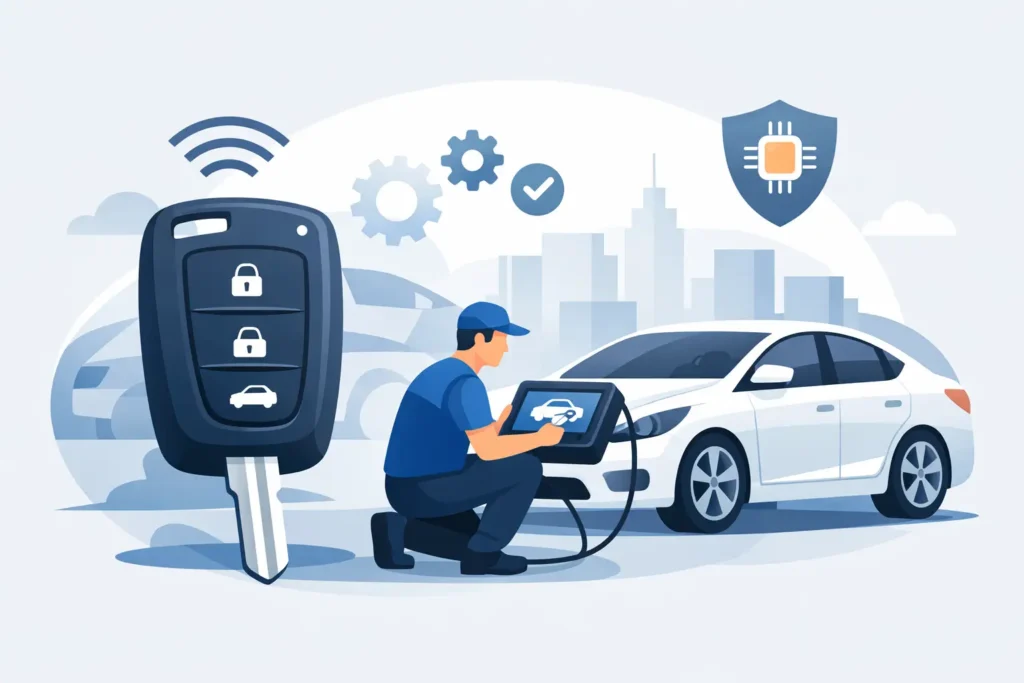
Mobile car key programming changes that equation. Instead of arranging transport, waiting for shop availability, and dealing with multiple service steps, the work can often be done where the vehicle sits. That is a major advantage when the issue happens at home, in a parking garage, at work, or on the roadside.
The other benefit is specialization. A general locksmith may be able to duplicate a simple key or help with a lockout, but not every provider handles advanced immobilizer procedures or module matching. When the problem involves starting authorization or replaced control units, the tools and experience behind the service matter.
That is where a mobile specialist like Car Kez stands apart. The value is not just convenience. It is bringing key cutting, transponder and smart key programming, and higher-level diagnostics directly to the vehicle without sending the customer through dealership delays.
What drivers should expect from the service call
A proper service visit usually starts with identifying the exact vehicle configuration and key type. From there, the technician verifies whether the issue is lost keys, a bad key, an immobilizer fault, or a larger module communication problem. That step matters because it shapes the programming method and avoids unnecessary parts.
If a new key is needed, the key may need to be cut first, then programmed to the immobilizer and tested for both starting and remote functions. On some vehicles, all existing keys must be present during programming. On others, missing keys can be erased from memory for added security.
When the problem goes beyond the key, the visit may include fault code scanning, module health checks, and synchronization work between the immobilizer and control units. That is often the difference between a vehicle that starts once and a vehicle that is reliably repaired.
How to avoid repeat key problems
The best time to deal with key programming is before it becomes an emergency. If you only have one working key, getting a spare made and programmed is usually cheaper and simpler than waiting until all keys are lost. It also reduces the risk of being stranded by a dead battery in the key fob, internal chip failure, or accidental damage.
It is also worth avoiding unknown online key purchases unless the exact compatibility has been verified. A low-cost key can become expensive if it cannot be programmed, fails early, or creates confusion during diagnosis. With vehicle security systems, close enough is usually not good enough.
If your car shows signs like intermittent no-starts, key not detected messages, or remote functions working inconsistently, deal with it early. Those symptoms rarely improve on their own, and they often point to a key, antenna, battery, or module issue that is easier to solve before a full failure happens.
When your vehicle does not recognize the key, the real problem is usually deeper than the blade in your hand. The fix comes from getting the electronics, security system, and vehicle modules working together again – and that is exactly where the right programming service makes the difference.
Pingback: Car Lockout Service That Gets You Moving Again - Car Kez
Pingback: Comment lire les codes défaut d’une voiture - Car Kez
Pingback: Car Door Lock Not Working? Find the Cause - Car Kez
Pingback: Immobilizer Problems Explained for No-Start Cars - Car Kez
Pingback: Can Locksmiths Cut Laser Keys for Your Car? - Car Kez