
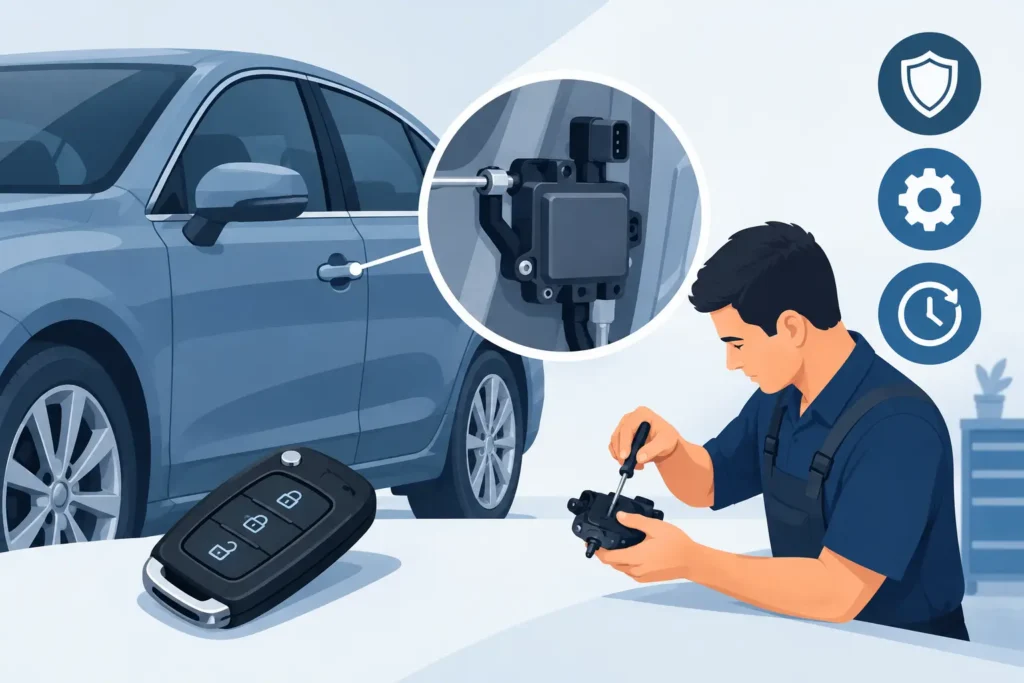
A door that will not lock is more than an annoyance when you are trying to park at work, load children into the car, or leave it overnight. Central locking repair for cars starts with finding the real failure point, not simply replacing the battery in the key fob or forcing a stubborn door lock. Modern vehicles combine mechanical latches, door actuators, wiring, remote keys, and body control modules. A fault in any one of those areas can leave you with a door that stays open, a car that locks itself back up, or a remote that appears completely dead.
Signs Your Central Locking System Needs Attention
The most obvious sign is a door that does not respond when you press lock or unlock on the remote. But the pattern matters. If one door fails while every other door works normally, the problem is often local to that door: its actuator, latch assembly, connector, or wiring through the door jamb.
If all doors stop responding at once, the cause may be different. A weak key fob battery is possible, but so are a blown fuse, low vehicle battery voltage, a receiver issue, or a body control module fault. Some vehicles may still lock with the interior switch but ignore the remote. Others may respond to the remote but not the switch. Those details help narrow the diagnosis before parts are changed.
Watch for intermittent behavior as well. Locks that work only after several button presses, doors that make a clicking or grinding sound, and a lock pin that moves halfway then returns are common warnings that an actuator or latch is wearing out. Addressing the issue early can help avoid a complete lockout or an unsecured vehicle.
What Causes Central Locking Failures?
Central locking is a system, so a correct repair depends on how the vehicle is behaving. The following are the most common causes, but they do not all require the same repair.
Failed door lock actuator or latch
An actuator is the small electric motor and gear assembly that moves the locking mechanism inside the door. On many newer vehicles, it is integrated into the latch assembly. Over time, its motor can weaken, plastic gears can wear, or internal switches can fail.
A failing actuator often creates a repeated click, a slow-moving lock, or a door that works inconsistently. If only one door is affected, this is a strong possibility. Replacing the actuator or latch may be the right fix, but the door wiring should still be checked first. Installing a new part will not solve a broken wire or corroded connector.
Damaged wiring in the door jamb
Every time a door opens and closes, the wiring harness flexes inside the rubber boot between the door and the vehicle body. After years of use, wires can crack internally, especially on the driver’s door. This can cause central locking to work only when the door is in a certain position or fail without warning.
Wiring faults can be deceptive because the insulation may look intact. Proper testing involves checking power, ground, and command signals under load, not just looking for visible damage. A basic continuity test alone may miss a wire that separates when the harness bends.
Key fob, receiver, or programming issue
A remote that has lost synchronization, suffered water damage, or has a depleted battery may not communicate with the vehicle. However, a non-working remote does not automatically mean the remote is the problem. If a spare remote also fails, or if the interior lock switch is acting strangely, the vehicle should be diagnosed before a replacement fob is programmed.
Some vehicles require a programming procedure after a new remote, key, BCM, or other module is installed. This is particularly relevant for smart-key systems, where access functions and immobilizer authorization are connected. The vehicle may recognize the key enough to start, yet still have remote locking functions that require configuration or module matching.
Fuse, battery, or body control module fault
Low system voltage can produce confusing electrical symptoms. A weak vehicle battery may cause locks to cycle slowly, operate inconsistently, or stop working after the car sits for several days. Checking battery condition and charging voltage is a sensible early step.
When multiple electrical features fail together, such as power windows, interior lights, trunk release, or central locking, the body control module may be involved. The BCM manages many convenience and access functions. It may have a stored fault code, a communication issue, water damage, or require programming after replacement. This is where OEM-level diagnostics make a meaningful difference.
Why Accurate Diagnosis Matters Before Repair
Central locking repair for cars is not a one-part-fits-all service. A door lock actuator can be a reasonable repair on a high-mileage vehicle with one dead door. But replacing several actuators because the remote stopped working everywhere can become an expensive guess.
A technician should first confirm the complaint, test the vehicle battery, inspect relevant fuses, and compare commands at the switch, remote, and affected doors. Diagnostic scanning can reveal faults in the BCM, door modules, keyless-entry system, or network communication. On vehicles with advanced electronics, live data can show whether the car is receiving a lock command and whether the module is sending an output to the door.
There are trade-offs in repair decisions. An older vehicle with a worn actuator may benefit from a direct mechanical repair. On a newer vehicle, the latch may be part of a larger electronic assembly, and a low-quality aftermarket part can create repeat issues or communication faults. The best option depends on the vehicle, the availability of quality parts, and whether programming is required after installation.
What a Professional Repair May Include
The repair process should match the cause. A mechanical issue may involve removing the interior door panel, testing the latch and actuator, replacing the failed component, and verifying that both the manual and electronic locking functions work correctly. Care is needed to avoid breaking trim clips, damaging vapor barriers, or interfering with window components.
For electrical faults, the work may include repairing damaged wires, cleaning or replacing corroded connectors, restoring a proper ground, or addressing a fuse or power supply problem. If the key fob is the issue, battery replacement, remote testing, or programming may restore operation.
When a BCM, door module, or replacement electronic component is involved, programming and configuration can be necessary. A module that is physically installed but not correctly matched to the vehicle may leave central locking, keyless entry, or other body functions unavailable. Car Kez brings diagnostic and programming capability to the vehicle, which can be especially useful when a lock or electronic access problem makes a trip to a shop impractical.
When to Call for Mobile Central Locking Help
Some issues can wait for a scheduled repair, such as a rear door that remains locked but does not affect daily driving. Others deserve immediate attention. If the driver’s door will not lock, the vehicle unlocks by itself, keys are trapped inside, or the lock failure is paired with a no-start or immobilizer warning, get the system checked promptly.
Mobile service is also valuable when the car cannot be secured where it is parked or when a module issue prevents normal key recognition. In Greater Montreal, an on-site specialist can inspect the vehicle at home, work, or roadside and determine whether the issue is mechanical, electrical, or programming-related. That avoids arranging a tow based on an assumption.
Avoiding Repeat Door Lock Problems
Do not force a lock button, handle, or key blade when the mechanism is binding. Force can turn a minor actuator problem into a damaged latch or broken linkage. Keep key fobs dry, replace their batteries when response becomes weak, and have water leaks around doors or windshield areas addressed before corrosion reaches connectors and modules.
If one lock begins clicking or operating slowly, treat it as an early warning. A focused diagnosis while the system still partly works is usually easier than dealing with a fully failed door on the day you need secure access. The right repair should leave you with locks that respond consistently, doors that secure properly, and confidence that your vehicle is protected when you walk away.