
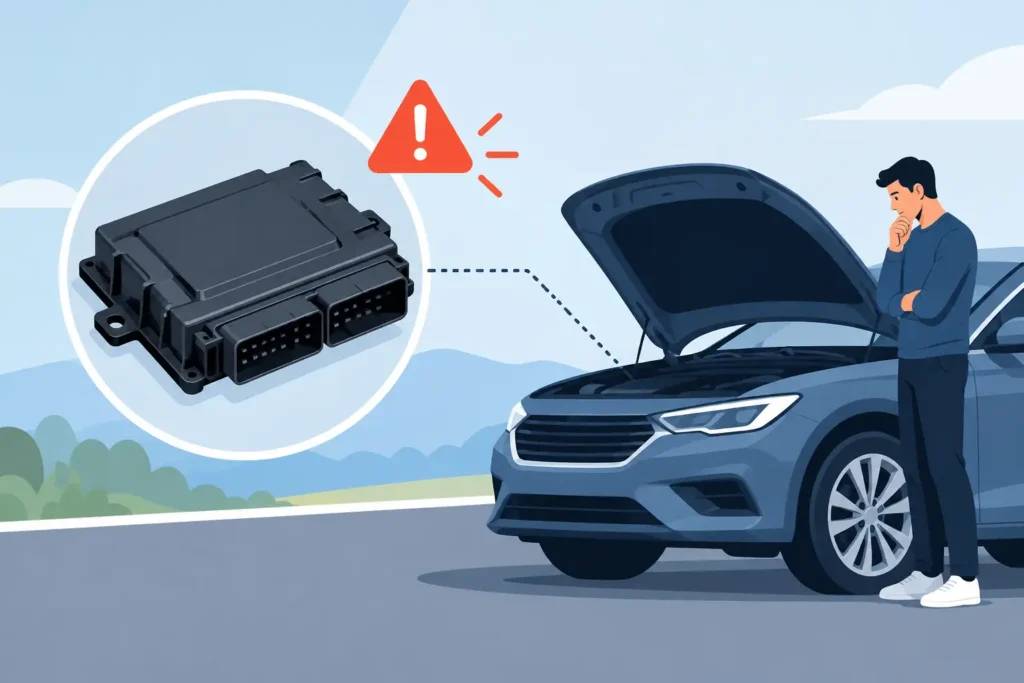
A vehicle that suddenly will not unlock, start, or recognize its key can feel like several problems happening at once. In many late-model vehicles, those functions may be tied to one control unit: the Body Control Module, or BCM. Knowing how to identify faulty BCM behavior can help you avoid replacing the wrong part, paying for unnecessary towing, or being stuck with a vehicle that will not start.
The BCM is not a wearable mechanical component like a starter or alternator. It is an electronic module that communicates with other systems across the vehicle. That means its symptoms can look confusing, intermittent, and sometimes unrelated. A proper diagnosis matters.
What a BCM Does in Your Vehicle
The BCM manages many of the vehicle’s body and convenience functions. Depending on the make and model, it may control power locks, remote keyless entry, interior and exterior lighting, power windows, wipers, alarm functions, horn operation, trunk release, instrument-cluster messages, and communication with the immobilizer system.
On some vehicles, the BCM plays a direct role in key recognition and starting authorization. If it cannot communicate correctly with the ECU, immobilizer, smart key module, or gateway module, the engine may crank without starting or may not crank at all.
That does not mean every electrical issue points to the BCM. A weak battery, corroded ground, damaged fuse, water intrusion, wiring fault, failed key fob, or another module can create nearly identical symptoms. The goal is to find evidence before making a diagnosis.
Common Signs of a Faulty BCM
A failing BCM often produces patterns rather than one clean, obvious failure. You may notice several body-electrical functions acting up at the same time, especially functions that normally have no reason to fail together.
For example, the power locks may work inconsistently while the interior lights stay on, the wipers activate unexpectedly, or the alarm goes off without cause. You might also see warning messages on the dashboard, accessories that continue running after the vehicle is shut off, or a battery that repeatedly goes dead overnight.
Key-related symptoms deserve close attention. The remote may stop unlocking the vehicle even with a good fob battery. A push-button-start vehicle may display “Key Not Detected,” “Immobilizer Active,” or a similar warning despite using a known working key. In certain cases, the vehicle starts intermittently, then later refuses to recognize any programmed key.
Other warning signs include:
- Multiple lights, locks, windows, or wipers behaving unpredictably
- A horn, alarm, or interior light activating without driver input
- Repeated no-start or key-recognition issues with no mechanical key problem
- Communication fault codes affecting several vehicle modules
- A parasitic battery drain caused by a module that will not enter sleep mode
One symptom on its own is not enough to condemn the BCM. A single dead power window could be a switch, motor, fuse, or broken door wiring. Several unrelated electrical problems appearing together is more meaningful.
How to Identify a Faulty BCM Without Guessing
The first step is checking the vehicle’s basic electrical health. Modern modules are sensitive to voltage. A weak battery can cause false warning lights, lost communication, key-detection problems, and erratic module behavior. Before testing a BCM, confirm that the battery is properly charged, battery terminals are clean and tight, and major grounds are intact.
Next, inspect the fuses and relays associated with body electronics, locking, ignition, and the BCM itself. A blown fuse may be the actual issue, but it can also be evidence of a short circuit. Replacing a fuse without finding why it failed can lead to the same problem returning.
Water damage is another major clue. BCMs are often installed under the dash, behind kick panels, near a fuse box, or in another protected-looking location. A windshield leak, blocked sunroof drain, flood exposure, or moisture entering through damaged seals can still reach the module or its connectors. Look for damp carpeting, corrosion on connectors, green residue on terminals, or signs of previous water intrusion.
After these basics, the vehicle needs a full electronic scan. Generic code readers can retrieve common engine codes, but they frequently miss BCM-specific data, manufacturer fault codes, module communication status, and live data. OEM-level diagnostic equipment can determine whether the BCM is online, whether it communicates with other modules, and whether it is receiving the inputs it needs to perform a command.
A technician may command a function through the scan tool, such as locking the doors or turning on an output, then verify whether the BCM responds. They can also compare live-data inputs. If the scan tool shows a door is closed when it is physically open, for example, the cause may be a door latch switch or wiring issue rather than the BCM itself.
Fault Codes Matter, But They Are Not the Final Answer
Communication codes, often beginning with “U,” can point toward a network problem. They may indicate that the BCM cannot communicate with the ECU, instrument cluster, steering-column module, smart key system, or another controller. But a communication code does not automatically mean the BCM has failed.
The issue could be low voltage, a damaged CAN-bus wire, corrosion at a connector, a missing power or ground supply, or a different module disrupting the network. This is why replacing modules based on code descriptions alone is risky.
A qualified diagnostic process checks BCM power feeds, grounds, network signals, connector condition, and module response. If all required inputs are present and the BCM still will not communicate or control its outputs, then module failure becomes much more likely.
When Key and Starting Problems Point to the BCM
If your vehicle has a lost-key situation, a newly replaced key, or an immobilizer warning, do not assume the BCM is defective right away. The key may need programming, the transponder may be incorrect, the smart key battery may be weak, or the immobilizer system may have lost synchronization after a low-voltage event.
However, BCM involvement becomes more likely when key programming repeatedly fails, the vehicle will not accept known good keys, or several access and body-electrical features fail alongside the no-start condition. Some vehicles require BCM, ECU, and immobilizer data to match. Replacing one module without proper programming or data transfer can leave the vehicle unable to start.
This is also why used BCMs are not always a simple plug-in fix. A replacement may need configuration, VIN writing, key learning, security access, proxy alignment, or synchronization with other modules. The exact procedure depends on the manufacturer and model year.
Can You Drive With a Faulty BCM?
It depends on what the BCM controls and how the failure presents. If the issue is limited to a convenience feature, such as one interior light or an intermittent door lock, the vehicle may still be drivable. Even then, the fault can worsen or drain the battery.
If the BCM affects headlights, wipers, brake-light circuits, security functions, or immobilizer authorization, driving may be unsafe or impossible. A vehicle that randomly loses lighting, activates the wipers, drains its battery, or refuses to start should be diagnosed promptly rather than treated as an inconvenience.
Avoid repeatedly jump-starting a vehicle with unexplained electrical problems. Voltage spikes and repeated low-voltage events can complicate diagnosis and may affect additional modules.
What a Proper BCM Repair Looks Like
The right repair begins with confirmation, not a replacement part. Sometimes the solution is repairing a power supply, ground, connector, water leak, wiring section, or related module. If the BCM itself has failed, replacement or cloning may be appropriate, followed by correct programming and system verification.
Afterward, the technician should confirm that keys are recognized, locks and lighting work correctly, relevant fault codes are cleared, and the vehicle enters sleep mode normally. On vehicles with security systems, verifying that the engine starts consistently is essential.
For drivers facing a no-start, key-recognition failure, or unexplained body-electrical problem, Car Kez can bring OEM-level diagnostics and module programming capability directly to the vehicle in Greater Montreal. This can be especially helpful when the vehicle cannot be driven to a dealership or shop.
A BCM problem is rarely solved by guesswork. When several electrical functions fail together, treat the pattern as useful evidence, protect the vehicle from low voltage and water exposure, and have the network and security systems tested before replacing anything. The right diagnosis is what gets you back on the road with confidence.