
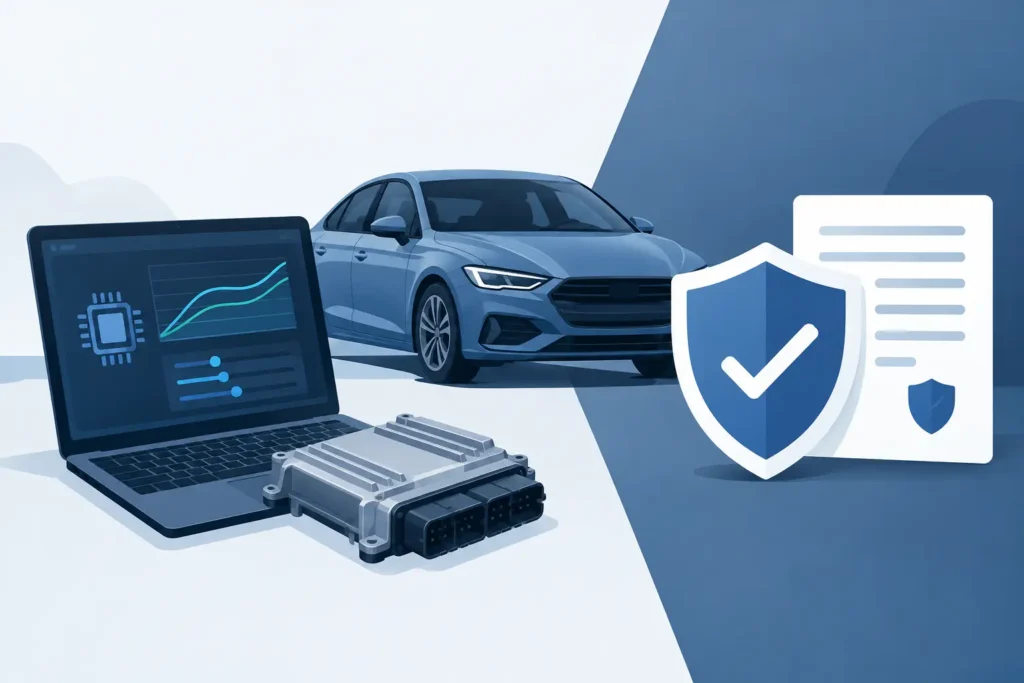
A replacement ECU that has not been programmed can leave a perfectly healthy vehicle unable to start. The immobilizer may reject the key, warning lights may appear, or the engine may crank without firing. In that situation, does ECU programming affect warranty coverage? It can, but the answer depends far more on what was programmed, why it was done, and whether the work is documented than on the word “programming” itself.
ECU programming is not automatically a warranty problem. Manufacturers program modules every day during repairs, recalls, software updates, and control-unit replacements. The risk changes when software is altered outside factory specifications, when a fault is ignored, or when an incorrect programming procedure damages a module.
What ECU programming actually means
The engine control unit, or ECU, manages critical engine functions such as fuel delivery, ignition timing, emissions systems, sensor interpretation, and communication with other modules. Programming can mean several very different things, and treating them all as the same service causes unnecessary confusion.
A legitimate repair may require an ECU to be matched to the vehicle identification number, immobilizer system, keys, transmission control module, or body control module. A module may also need factory calibration software after replacement. These procedures restore the vehicle to its intended operating condition. They are common after an ECU failure, water damage, collision repair, lost-key situation, or module replacement.
Performance tuning is different. A tune may change boost targets, fueling, ignition timing, torque limits, speed limiters, or emissions-related settings. Even if the vehicle feels stronger afterward, those changes may place components outside the conditions the manufacturer designed and warranted.
The distinction matters: restoring factory operation is not the same as modifying factory operation.
Does ECU programming affect warranty coverage?
Factory-level programming performed as part of a proper diagnosis or repair does not usually void an entire vehicle warranty. If an ECU needs to be synchronized with the immobilizer after a replacement, for example, that work is often necessary to make the vehicle start and secure it against unauthorized keys.
However, a manufacturer or warranty administrator may deny a specific repair if it can reasonably connect the failure to a non-factory software modification, improper programming, or an incompatible part. A powertrain claim after an aggressive engine tune may receive close scrutiny. A claim for a failed radio speaker or window regulator would be much harder to connect to that tune.
The key point is that warranty coverage is generally evaluated claim by claim. One electronic modification does not automatically erase every protection on the vehicle. At the same time, a warranty is not a blank check for damage caused by altered software, misuse, or an improperly installed module.
For U.S. vehicles, consumer warranty rules generally prevent a manufacturer from refusing coverage simply because an aftermarket part or service exists. Still, if the manufacturer can show that the modification caused or contributed to the failure being claimed, coverage for that repair may be denied. Warranty language, vehicle age, and local consumer-protection rules can affect the outcome, so the written warranty remains the starting point.
When programming is usually low risk
Programming is generally easier to defend when it follows the manufacturer’s original configuration and solves a documented fault. Examples include replacing a failed ECU with a correct unit, updating module software to address a known drivability issue, or adapting replacement modules so the vehicle’s security system recognizes them.
A professional technician should first verify why the vehicle is not starting or communicating. A no-start condition can come from a weak battery, corroded wiring, water intrusion, a failed sensor, a BCM issue, or a key and immobilizer mismatch. Programming a module without diagnosis may not solve the real problem and can complicate later warranty discussions.
OEM-level diagnostic tools are valuable because they can identify fault codes, module status, software versions, and communication problems before changes are made. They also help ensure that a replacement ECU, BCM, or TCM is configured correctly for the vehicle rather than programmed with generic or incompatible data.
If your vehicle is under warranty, ask for a clear explanation of the work before programming begins. You want to know whether the procedure restores original software, installs a manufacturer update, or changes operating parameters. Those are very different decisions.
Situations that can create warranty trouble
The greatest warranty risk comes from aftermarket calibration changes. Performance tunes can increase cylinder pressure, exhaust temperatures, transmission torque load, or stress on turbochargers and fuel-system components. If a related component fails, the manufacturer may examine the ECU history and calibration data during the claim process.
Emissions-related modifications can be especially serious. Altering or disabling emissions monitoring, catalytic-converter functions, or other emissions controls may create legal issues as well as warranty concerns. It can also lead to inspection failures, warning lights, reduced resale value, and expensive repairs when factory software must later be restored.
Improper module programming is another risk. A programming interruption caused by low voltage, unstable communication, or incorrect files can corrupt a control unit. Using a low-quality used ECU without confirming part compatibility may create further issues with the immobilizer, transmission, options, or network communication.
Be cautious with the idea that a tune can simply be removed without a trace. Modern vehicles may store programming counters, calibration identifiers, event records, and fault history. Restoring stock software may improve operation, but it does not guarantee a manufacturer will be unable to identify prior changes.
How to protect yourself before any ECU work
Start by describing the symptom, not the solution you think you need. “My car will not start after the battery died” gives a technician useful direction. “I need the ECU programmed” may skip the diagnostic step that identifies a key, BCM, wiring, or voltage issue instead.
Before approving work, confirm whether the proposed service will retain factory calibration. Ask whether the technician will scan all relevant modules, verify battery voltage, back up existing data where possible, and document the final result. A reputable specialist should be comfortable explaining the difference between repair programming and performance modification in plain language.
Keep your service records. Save the diagnostic report, invoice, module part number, software information when available, and the reason for replacement or programming. If you later need warranty service, this documentation shows that the work was performed to correct a specific issue rather than to alter the vehicle’s performance.
It also helps to avoid mixing unrelated changes into an active warranty repair. If the vehicle has an unresolved engine or transmission concern, do not add an aftermarket tune and expect the claim process to remain simple. Resolve the original concern, retain the paperwork, and make informed changes afterward.
Why mobile programming still needs professional standards
Convenience should not mean shortcuts. When a vehicle is disabled in a driveway, parking lot, or workplace, towing it to a dealer can add time and cost. But ECU, BCM, TCM, and immobilizer work still requires stable power, correct diagnostic equipment, verified module compatibility, and a technician who understands the vehicle’s security system.
This is where a qualified mobile specialist can make a practical difference. The right service can diagnose the issue on-site, program replacement components when appropriate, and get you back on the road without treating every no-start as a simple key problem. Car Kez brings that OEM-level diagnostic approach to vehicle owners across Greater Montreal, particularly when a module, key, and immobilizer must work together.
Make the decision based on the purpose of the work
If programming restores the correct factory configuration after a verified fault or module replacement, it is usually a normal repair step and should be documented as such. If it changes how the engine, transmission, or emissions systems operate beyond factory specifications, expect a higher chance of warranty disputes for related failures.
When your vehicle will not start, the smartest move is not to guess at the ECU. Get the system diagnosed, understand the programming being proposed, and keep a record of work that returns the vehicle to the condition it was built to deliver.