
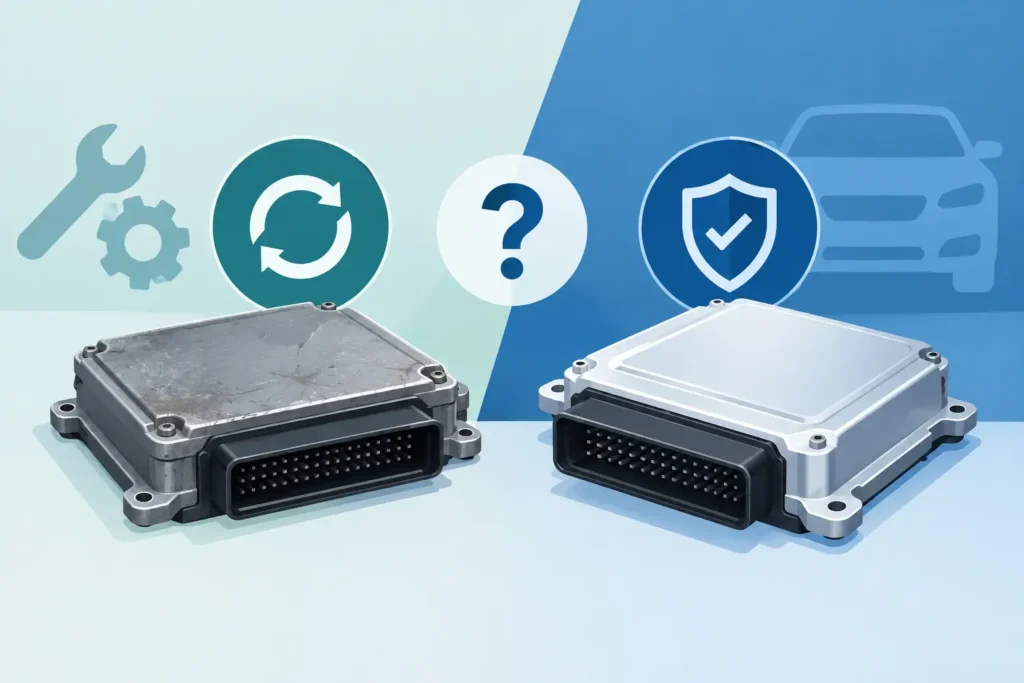
A no-start vehicle after an ECU failure is rarely solved by installing the first module you can find. The choice between an ECU reconditionné ou neuf affects more than the price of the part. It affects whether the vehicle recognizes its keys, communicates with other modules, meets its original calibration requirements, and gets back on the road without repeat repairs.
For many drivers, a reconditioned ECU is a practical answer. For others, especially when the vehicle has strict software, emissions, or warranty requirements, a new OEM unit is the safer route. The right decision starts with a confirmed diagnosis and a clear plan for programming.
First, Confirm That the ECU Is Actually the Problem
The engine control unit, or ECU, manages critical engine functions such as fuel delivery, ignition timing, sensor inputs, throttle operation, and communication with other vehicle modules. A failed ECU can cause a crank-no-start condition, warning lights, loss of communication during diagnostics, or erratic drivability.
Those symptoms can also come from a weak battery, damaged wiring, water intrusion, poor grounds, blown fuses, a failed relay, a faulty sensor, or an immobilizer issue. Replacing an ECU before testing these basics can turn a smaller repair into an expensive one.
A proper diagnostic process checks power and ground at the ECU, scans all available modules, verifies communication on the vehicle network, and reviews fault codes and live data. If the ECU is not communicating, the technician still needs to determine whether the module itself has failed or whether the vehicle cannot reach it because of a wiring or network fault.
This step matters because a replacement ECU may not solve a key or security-related no-start. On many vehicles, the ECU, immobilizer, body control module, and transponder keys must agree with each other before the engine will start.
Reconditioned ECU vs. New ECU
A reconditioned ECU is an original module that has been repaired, tested, or rebuilt for reuse. Depending on the supplier and the fault, this can involve replacing damaged electronic components, correcting common circuit-board failures, repairing water damage, and testing the module under simulated operating conditions.
A new ECU is a factory-supplied module that has not been previously installed in another vehicle. It generally arrives blank, partially configured, or loaded with base software that must be programmed to the vehicle.
Neither option is automatically better in every situation. The quality of the part, the availability of the correct calibration, and the programming process matter as much as whether the ECU is new or reconditioned.
When a reconditioned ECU makes sense
A reconditioned ECU can be a strong option when the original module has a known repairable failure, the correct part number is available, and the supplier has a proven testing process. It can reduce the cost of repair substantially compared with a new OEM unit, particularly on older vehicles where a new module is expensive or discontinued.
It may also be the most realistic option when a manufacturer no longer supplies new units. In that case, a properly repaired original ECU or a compatible reconditioned unit can keep an otherwise dependable vehicle in service.
The key word is properly. A low-cost used ECU sold as “tested” is not the same as a professionally reconditioned unit. A used module may carry unknown internal damage, incorrect software, a different immobilizer identity, or configuration data from another vehicle. It can appear to fit physically and still prevent the vehicle from starting.
When a new ECU is the better choice
A new ECU is often the preferred choice for newer vehicles, vehicles still covered by warranty, and applications where software accuracy is critical. It offers a clean starting point with current manufacturer programming and no history of prior heat, moisture, vibration, or electrical damage.
New is also worth considering when the vehicle has a complicated emissions configuration, advanced driver-assistance systems, or multiple related modules that require exact software compatibility. In these cases, the lower upfront cost of a reconditioned unit can disappear quickly if the unit will not accept the needed calibration or creates communication faults.
The trade-off is cost and availability. New ECUs can be expensive, may need to be ordered, and still require setup after installation. A new module is not usually plug-and-play.
Programming Is Part of the Repair
Many ECU replacements fail at the final step because programming was treated as an afterthought. Modern vehicles store identification and security information across several modules. The replacement ECU may need its vehicle identification number written, the correct software flashed, and its immobilizer data synchronized with the existing keys and security system.
Depending on the make and model, the job may require ECU cloning, immobilizer reset procedures, online programming, key relearning, throttle adaptation, injector coding, crankshaft variation relearn, or transmission-related setup. Some vehicles require stable battery voltage throughout the process. A voltage drop during programming can corrupt a module and create additional problems.
This is why matching only the visible part number is not enough. Hardware numbers, software versions, engine options, transmission type, emissions packages, and market specifications can all affect compatibility.
Cloning an ECU can save time, but it is not always possible
When the original ECU is readable and not severely damaged, cloning may allow relevant data to be transferred to a compatible replacement unit. This can preserve immobilizer information and reduce the amount of security programming required afterward.
However, cloning is not available for every vehicle or every ECU failure. If the original module has no communication, damaged memory, or extensive water damage, its data may not be recoverable. Some newer systems also use protected data that requires manufacturer-level procedures rather than a simple data transfer.
A capable technician should explain whether cloning is realistic before a replacement unit is ordered. Promising a clone without first assessing the original ECU creates unnecessary delays.
Questions to Ask Before Choosing an ECU
Before authorizing the repair, ask whether the ECU fault has been verified, whether the replacement part is new, reconditioned, or simply used, and whether it carries a meaningful warranty. You should also confirm that the unit will be matched to your exact vehicle configuration and that programming, immobilizer synchronization, and key relearning are included in the repair plan.
If your car has been sitting because it will not start, ask whether the work can be performed where the vehicle is located. Towing a disabled vehicle to a dealer or electronics shop adds cost and time, especially when the issue also involves keys or an immobilizer.
For drivers in Greater Montreal, Car Kez can bring OEM-level diagnostic and module-programming capability to the vehicle, which is especially useful when an ECU replacement must be synchronized with the existing keys and security system on-site.
Avoid These Common ECU Replacement Mistakes
The most common mistake is buying a module based only on the vehicle year and engine size. Two vehicles built in the same year can use different ECU hardware or calibrations. Always verify the original module details and the vehicle’s full configuration.
Another mistake is ignoring the reason the original ECU failed. If water entered the ECU housing, a connector is corroded, a charging-system problem caused voltage spikes, or a wiring short damaged the module, installing another ECU without correcting the cause can damage the replacement.
Finally, do not assume a no-start after ECU installation means the replacement is defective. It may simply be waiting for security matching, software programming, or a required relearn procedure. A targeted diagnostic check is faster and less costly than replacing parts again.
Make the Decision Based on the Whole Repair
Choose a reconditioned ECU when it is professionally rebuilt, properly matched, and supported by a clear programming plan. Choose a new ECU when current factory software, long-term certainty, warranty considerations, or complex vehicle configuration justify the higher investment.
The best value is not always the cheapest module. It is the repair that identifies the real fault, installs the correct unit, programs it correctly, and leaves you with a vehicle that starts reliably when you need it.