
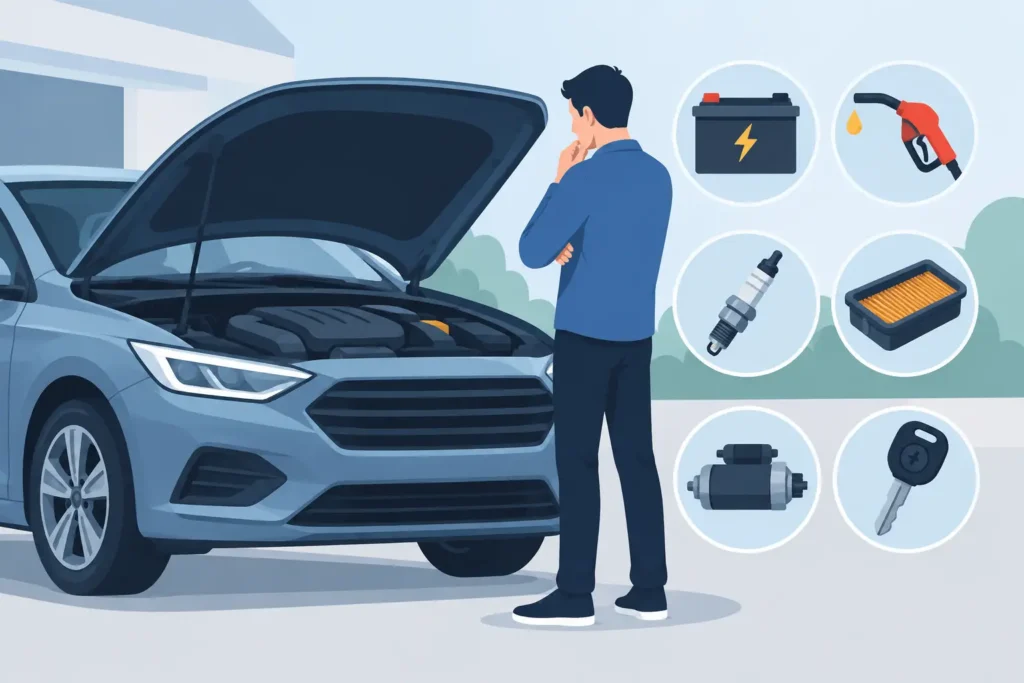
The starter is turning, the engine is cranking, and yet the vehicle will not run. If you are searching why car cranks not starts, that distinction matters: the battery has enough power to operate the starter, but the engine is missing something it needs to fire and keep running.
A cranking no-start can be caused by anything from a weak key fob battery to a failed fuel pump, a damaged crankshaft sensor, or an immobilizer that is no longer recognizing the key. Modern vehicles also rely on communication between the ECU, BCM, and other modules. When that electronic handshake fails, a perfectly good engine may be prevented from starting.
Why a Car Cranks but Does Not Start
For an engine to start, it needs the correct combination of fuel, air, spark, compression, and timing. On newer vehicles, it also needs authorization from the anti-theft system. Cranking only confirms that the starter circuit is working well enough to turn the engine. It does not confirm that fuel is being delivered, the ignition is producing spark, or the vehicle recognizes the key.
The first clue is how the vehicle behaves. Does it crank normally but never try to catch? Does it start for one or two seconds, then stall? Is there a security light flashing on the dash? Did the problem begin after losing a key, replacing a battery, changing an ECU, or experiencing water damage? Those details narrow the diagnosis quickly.
A weak battery can still crank the engine
It sounds contradictory, but a battery can turn the starter and still create a no-start condition. Voltage may drop sharply while cranking, leaving sensitive modules, fuel injectors, or ignition components without stable power. Corroded battery terminals and poor ground connections can cause the same problem.
If the dashboard lights dim dramatically, the crank becomes slower after a few attempts, or you hear rapid clicking after trying again, start with the battery and cable connections. A jump-start may help identify a low-voltage issue, but it does not prove the battery is healthy. It also will not repair a charging-system fault or a loose ground.
Fuel is not reaching the engine
A failed fuel pump, blown fuel-pump fuse, faulty relay, clogged filter, or wiring fault can leave an engine cranking with no combustion. In many vehicles, you may hear a brief hum from the fuel tank for a few seconds when the ignition is switched on. No sound does not automatically mean the pump has failed, but it is a useful clue.
Fuel issues often show up as a vehicle that cranks normally and occasionally sputters, especially after sitting. Some vehicles may start with starting fluid during testing, which can point technicians toward a fuel-delivery problem. This is not a good roadside experiment for most drivers, since incorrect use can create a fire risk or mask the real fault.
No spark or incorrect engine timing
Gasoline engines need a strong, correctly timed spark. Failed ignition coils, worn spark plugs, damaged wiring, and faulty camshaft or crankshaft position sensors can stop that spark from occurring at the right moment. A crankshaft sensor fault is a common example: the starter spins the engine, but the ECU cannot determine engine speed or position well enough to command ignition and fuel injection.
Timing-belt or timing-chain problems are more serious possibilities. If an engine cranks unusually fast or sounds different than normal, stop repeated starting attempts. Continuing to crank a vehicle with a mechanical timing problem can increase damage on some engines.
When the Key or Immobilizer Is the Real Issue
A vehicle can crank but refuse to start when the immobilizer does not recognize the transponder key or smart key. This is especially common after a lost-key situation, a poorly programmed replacement key, water damage, a depleted smart-key battery, or module work.
Many vehicles will show a key, padlock, or security indicator on the instrument panel. Some will start briefly and then shut off. Others will crank continuously but disable fuel injection or ignition from the beginning. The exact behavior depends on the make, model, and anti-theft system.
Before assuming the engine has a mechanical failure, try a known working spare key if you have one. Keep a smart key inside the vehicle and use the manufacturer-designated emergency starting position if applicable. On many push-button vehicles, holding the fob directly against the start button can help when the fob battery is weak, but the procedure varies by vehicle.
If a spare key starts the vehicle, the original key likely needs battery service, repair, or programming. If neither key works and the security warning remains active, the problem may involve the key, immobilizer antenna, BCM, ECU, or communication network.
Replacement modules may need programming
Installing a used or replacement ECU, BCM, ignition switch, or instrument cluster is not always plug-and-play. These components can store security data, vehicle identification information, and immobilizer credentials. If they are not correctly matched or programmed, the engine may crank but remain locked out from starting.
This is where generic code readers often fall short. A basic scanner may display a fault code but cannot always access the immobilizer functions, live data, module configuration, or OEM-level programming needed to identify the actual failure. Proper diagnosis may involve checking whether the ECU sees engine RPM while cranking, whether the BCM recognizes the key, and whether modules are communicating on the network.
What You Can Safely Check Before Calling for Help
Avoid draining the battery with repeated 10- or 15-second crank attempts. Try one or two short attempts, then look for changes in warning lights, crank speed, or engine behavior. Check that the vehicle has fuel, even if the gauge shows some remaining. A faulty fuel-level sender can be misleading.
Make sure the battery terminals are secure and free of heavy corrosion. For an automatic vehicle, try starting in Neutral as well as Park. For a manual transmission, fully depress the clutch and confirm that floor mats or debris are not blocking the pedal. If the vehicle has a spare key, test it once.
Do not force the ignition, repeatedly press the start button, or attempt to bypass anti-theft wiring. Those actions can damage components, create additional fault codes, or make a programming issue more difficult to resolve.
When Mobile Diagnostics Are the Better Next Step
A vehicle that cranks but will not start may not need a tow. If the issue points to a key, immobilizer, ECU, BCM, or module synchronization fault, on-site diagnostics can save time and avoid the delay of sending the vehicle to a dealership.
Car Kez brings OEM-level diagnostic and programming capability to vehicles across Greater Montreal, including transponder and smart-key programming, immobilizer-related no-start diagnostics, and critical module matching. That matters when the vehicle is parked at home, at work, or stranded where a tow is inconvenient.
A proper diagnostic process should identify the cause before parts are replaced. Fuel pressure, battery voltage under load, security authorization, sensor signals, fault codes, and module communication all need to be considered together. Replacing a fuel pump when the immobilizer is blocking the start command, or replacing a key when the ECU has lost communication, wastes money and extends the downtime.
If your vehicle cranks but does not start, treat the dashboard warnings and the vehicle’s recent history as useful evidence. A clear diagnosis is the fastest route back on the road, whether the answer is a simple battery connection, a programmed key, or specialized electronic module service.