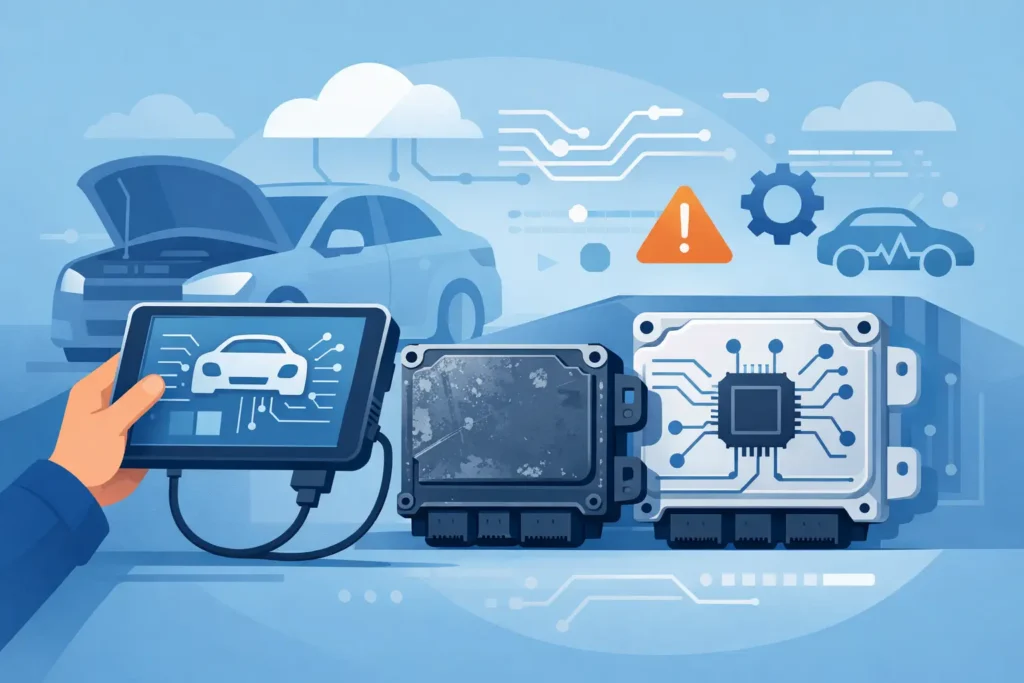
A replacement ECU from another vehicle can look like a quick fix until the car still will not start. That is where ecu programming for used module replacement becomes the real job, not just swapping the part. In many modern vehicles, the ECU is tied to the immobilizer, key data, VIN information, and other control units, so a used module often needs to be matched properly before the vehicle will run normally.
This is the part many vehicle owners do not see coming. A used ECU may be physically correct, have the same part number, and still fail to communicate the way the vehicle expects. The issue is rarely the box itself. It is usually the stored data inside it and how that data conflicts with the rest of the car.
Why ecu programming for used module replacement is often necessary
A modern vehicle is not built around one standalone computer. The ECU works in a network with the BCM, immobilizer, instrument cluster, transmission control module, gateway, and key system. When one module is replaced with a used unit, that network may reject it.
That rejection shows up in ways that feel confusing to the driver. The engine may crank and not start. It may start and stall. The security light may stay on. Communication codes may appear. In some cases, the vehicle seems dead even though the replacement module was sold as tested and working.
This happens because many ECUs store identifying data from the original vehicle. That can include VIN, immobilizer sync data, coding, software calibration, and component protection information. If the used module still carries another vehicle’s identity, your car may treat it like an intruder.
What programming actually involves
Programming is not always one single step. Depending on the make, model, and year, ecu programming for used module installation can involve reading the original unit, extracting security data, resetting or virginizing the donor module, writing coding, adapting keys, and performing relearn procedures.
Sometimes the process starts with cloning. If the original ECU still communicates well enough, critical data can be copied from the failed unit to the donor unit. That can reduce complications because the replacement now carries the same identity your vehicle already recognizes.
Other times the original ECU is too damaged to read. In that case, the technician may need to pull immobilizer data from another module, use OEM-level diagnostics to adapt the used ECU, and then complete key matching and system initialization. On some vehicles, online access or manufacturer-specific functions are required. On others, EEPROM or bench programming is the only practical route.
That is why this work is more than code clearing or plugging in a scanner. The tool matters, but the procedure matters just as much.
Used ECU programming is not the same on every vehicle
Some cars accept a donor ECU with relatively straightforward adaptation. Others are much stricter. European brands are often known for stronger module matching and security layers, but domestic and Asian vehicles can be just as particular depending on the platform.
There are also major differences between engine control systems. Gasoline and diesel applications behave differently. Hybrid and late-model push-to-start systems add another level of complexity because the ECU may be only one part of a wider authorization chain.
This is where unrealistic expectations cause delays. A customer may hear that a friend replaced an ECU in 20 minutes on an older vehicle and assume the same applies to a newer one. It often does not. A 2008 model and a 2020 model can be worlds apart in how they handle module replacement.
Common signs a used module still needs programming
The most obvious sign is a no-start after installation, but that is not the only one. Sometimes the vehicle starts yet runs badly because the coding does not match the engine, transmission, or emissions setup. Sometimes accessories stop behaving correctly because the ECU and BCM are not aligned.
You may also see warning messages for immobilizer, steering lock, transmission, or communication faults. Check engine lights can appear with module mismatch codes, VIN errors, or lost communication faults. In some vehicles, the cluster may display messages related to anti-theft or incorrect software.
A used module can also create misleading symptoms. It may look like a bad battery, failed key, bad starter, or wiring issue until proper diagnostic work confirms the network is rejecting the module.
Why part number matching is only the start
Matching the part number is necessary, but it is not enough. Software version, hardware revision, engine family, emissions spec, drivetrain, and immobilizer generation can all affect compatibility.
Two ECUs with nearly identical labels may not behave the same once installed. A donor unit from a different market, trim level, or transmission configuration can create programming barriers or drivability problems. This is one reason online marketplace purchases can be hit or miss. The module may be advertised as compatible when it is only superficially similar.
A proper diagnostic approach checks more than the sticker. It confirms whether the donor unit can actually be adapted to the target vehicle and whether additional steps will be needed to make that happen.
The risks of trying to force a used ECU into service
When people are stuck with a disabled car, the temptation is understandable. Buy the cheapest used ECU, plug it in, clear codes, and hope for the best. Sometimes that works on older systems. On many modern vehicles, it leads to more downtime.
The main risk is not just that the car will not start. Incorrect programming can lock systems, erase valuable data, trigger anti-theft responses, or create a second failure that was not present before. Battery voltage problems during programming can also corrupt software.
There is also the issue of misdiagnosis. If the original problem was wiring, power supply, water damage, or another module on the network, replacing the ECU may solve nothing. Now you are dealing with the original fault and a used module that still needs proper setup.
Mobile programming makes more sense than towing in many cases
When a vehicle will not start after an ECU replacement, the usual next step is towing it to a dealer or specialty shop. That adds cost and delay right away. For many owners, especially when the vehicle is stuck at home, at work, or roadside, a mobile service is the more practical route.
A technician with OEM-grade diagnostics and module programming capability can assess the installation on-site, confirm communication, identify whether the donor ECU is compatible, and complete the necessary adaptation if the platform allows it. That saves time and removes the hassle of arranging transport for a non-running vehicle.
This is where a field-based specialist brings real value. The issue is not just electronic. It is logistical. If the car cannot move, the solution should.
What to expect during ecu programming for used module service
The first step should always be diagnosis, not assumptions. The technician checks whether the replacement ECU powers up, communicates on the network, and matches the vehicle closely enough for adaptation. Fault codes, immobilizer status, key recognition, and related modules all need to be reviewed.
If the setup is viable, programming may involve data transfer, coding, relearns, or immobilizer matching. Some vehicles will also need throttle adaptation, crank variation relearn, injector coding, or transmission-related setup after the ECU is accepted.
If the donor unit is not compatible, that should be identified early rather than after hours of trial and error. A good service call is not just about making something work. It is about knowing when a module is the wrong candidate and preventing wasted time.
For drivers dealing with a no-start, security lockout, or post-replacement communication issue, that kind of clarity matters. Car Kez handles these situations with mobile diagnostics and on-site programming support, which means the vehicle can often be tested and corrected where it sits.
A used ECU can absolutely be the right solution, but only when the programming side is handled correctly. The part gets installed in minutes. Getting the vehicle to accept it is the part that gets you back on the road.
Pingback: BCM Replacement Programming Service Explained - Car Kez
Pingback: TCM Programming After Replacement Explained - Car Kez
Pingback: Car Key Programming: What Drivers Should Know - Car Kez
Pingback: Qu’est-ce qui cause un immobilizer no start ? - Car Kez
Pingback: Comment lire les codes défaut d’une voiture - Car Kez
Pingback: ECU Repair Versus Replacement – Which Fits? - Car Kez
Pingback: When You Need a Car Computer Flashing Service - Car Kez
Pingback: BCM Coding Process Guide for Vehicle Owners - Car Kez
Pingback: OEM Diagnostics Versus a Generic Scanner - Car Kez