
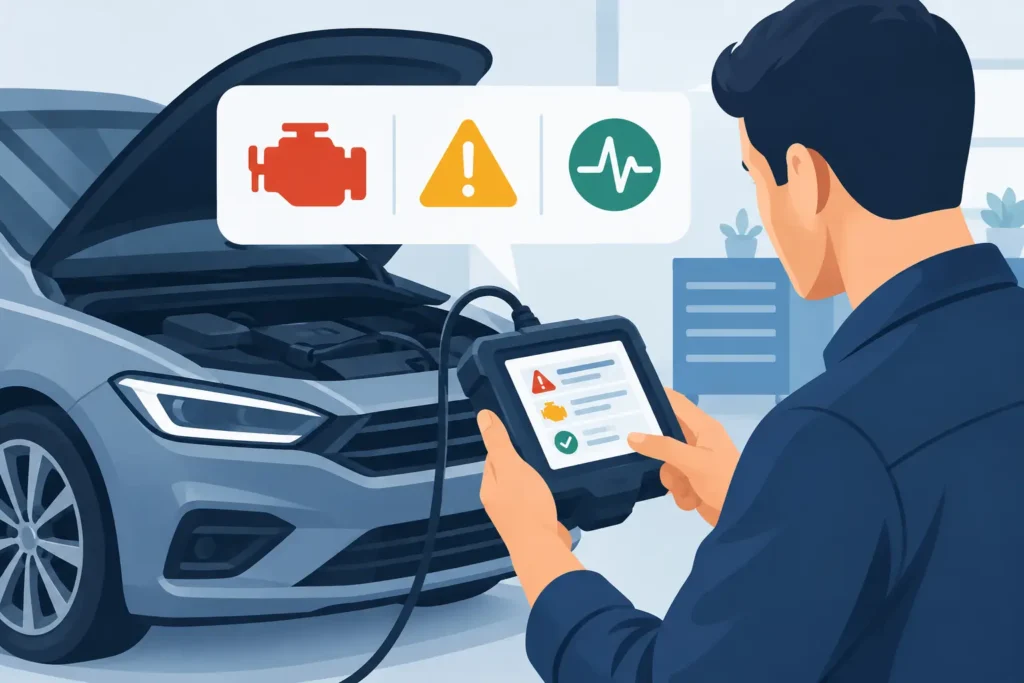
A check engine light can mean anything from a loose fuel cap to a communication failure between critical control modules. If you are searching for comment lire codes défaut voiture, the scanner is only the starting point. The useful part is knowing what the code means, what information supports it, and whether it is safe to keep driving.
What a vehicle fault code actually tells you
Modern vehicles constantly monitor sensors, wiring, fuel delivery, emissions equipment, transmission behavior, security systems, and electronic modules. When a module sees a reading or condition outside its expected range, it can store a diagnostic trouble code, often called a DTC.
A code does not automatically identify the failed part. For example, a code for an oxygen sensor circuit may be caused by the sensor itself, damaged wiring, a poor connector connection, an exhaust leak, or an engine condition affecting the sensor reading. Replacing the part named in a code description without testing is one of the most common and expensive diagnostic mistakes.
Most vehicles sold in North America since 1996 use OBD-II diagnostics for engine and emissions-related faults. A basic OBD-II scanner can retrieve many of these codes through the vehicle’s diagnostic port, usually located beneath the dashboard near the steering column. Manufacturer-level scan tools can access more systems, including the body control module (BCM), transmission control module (TCM), immobilizer, airbags, ABS, and other modules.
How to read car fault codes with an OBD-II scanner
Start with the vehicle parked safely, transmission in Park or Neutral, and the parking brake applied. Locate the 16-pin OBD-II port, connect the scanner, and turn the ignition to the ON position. On push-button vehicles, this usually means pressing the start button without pressing the brake pedal.
Let the scanner identify the vehicle automatically or enter the year, make, model, and engine when prompted. Select the diagnostic or scan function, then read stored codes. A good scanner may show several categories:
- Stored codes are confirmed faults that the module has recorded.
- Pending codes have been detected but may need another drive cycle before they trigger a warning light.
- Permanent codes generally remain until the vehicle confirms the issue has been repaired through its own monitoring tests.
- History codes may be saved by certain manufacturer-specific modules after the active condition is gone.
Before clearing anything, write down every code and its description. Take a photo of the scan screen if possible. Also save freeze-frame data, which records operating conditions when the code was set. Engine speed, coolant temperature, vehicle speed, fuel trim, and battery voltage can turn a vague code into a useful diagnostic direction.
Do not clear the codes simply to turn off the dashboard light. Clearing them erases valuable evidence, resets emissions readiness monitors, and can make an intermittent problem harder to find. If the light returns, you are back to where you started, but without the original data.
Understanding the letter and numbers
Most generic OBD-II codes follow a five-character pattern, such as P0301.
The first letter identifies the vehicle area: P is powertrain, covering engine and transmission; B is body systems; C is chassis systems; and U is network communication between modules. The first number after the letter often indicates whether the code is generic or manufacturer-specific. A 0 commonly identifies a standardized code, while 1 or higher may point to a code defined by the manufacturer.
Using P0301 as an example, the code indicates a cylinder 1 misfire. That still does not prove a spark plug is bad. The cause could be an ignition coil, fuel injector, vacuum leak, low compression, wiring problem, or a fault in the engine management system. The code identifies the symptom and location, not always the root cause.
Read the code in context, not by itself
A single fault code can be misleading. The best first step is to look for related codes and match them with the vehicle’s symptoms. A no-start condition with low-voltage codes across several modules may be a weak battery, loose terminal, blown fuse, or poor ground. It is not necessarily a failed ECU, BCM, or TCM.
Battery voltage matters more than many drivers expect. Modern vehicles rely on stable voltage for module communication, key recognition, throttle control, and transmission operation. A battery that appears strong enough to power lights may still drop too low during cranking and trigger multiple unrelated fault codes.
Pay attention to when the problem occurs. Does the warning light appear only after rain? Does the vehicle stall when warm? Did the issue begin after a battery replacement, collision repair, jump-start, or module replacement? These details help distinguish a mechanical failure from a wiring, programming, or module synchronization issue.
Live data is also more valuable than a code list alone. A professional scan tool can view sensor readings in real time, command certain components on and off, check module communication, and compare requested values with actual values. This is where OEM-level diagnostics save time and prevent unnecessary parts replacement.
When a fault code means stop driving
Some warnings require immediate caution. If the check engine light is flashing, the engine may have an active misfire severe enough to damage the catalytic converter. Reduce load on the engine, avoid hard acceleration, and arrange diagnosis rather than continuing a long drive.
Stop driving when you see an oil pressure warning, severe overheating, brake system warning, or a red battery warning accompanied by dim lights or steering problems. The scan code is secondary in these situations. Preventing engine, brake, or electrical damage comes first.
For transmission-related faults, do not assume the vehicle can safely continue because it still moves. Harsh shifting, slipping, failure to engage, or limp mode can point to a TCM issue, fluid pressure problem, wiring fault, or internal transmission concern. Continuing to drive may increase the repair cost.
Fault codes related to keys, immobilizers, and modules
Not every diagnostic issue turns on the check engine light. A vehicle that will not recognize its key, starts briefly and shuts off, displays an immobilizer message, or loses communication with a module may store body or network codes that a basic reader cannot access.
These cases often require access to the BCM, immobilizer system, ECU, gateway module, or instrument cluster. A replacement module may also need coding, configuration, VIN matching, security access, or key programming before the vehicle will start correctly. Installing a used module without proper programming can create additional no-start or communication faults.
This is especially relevant after lost-key situations, water damage, battery voltage events, collision repairs, or failed module replacement attempts. The right diagnosis checks power, ground, wiring integrity, module communication, and programming status before declaring a module defective.
For drivers in Greater Montreal dealing with a non-start, key recognition issue, or module mismatch, Car Kez can bring advanced diagnostic and programming capability to the vehicle. That avoids towing a disabled car solely to retrieve codes or complete critical electronic matching.
When a basic scanner is enough and when it is not
A basic scanner is useful for reading generic engine codes, checking whether a repair appears successful, and giving a technician better starting information. It is often enough for simple issues, such as confirming a recurring evaporative emissions fault or identifying a misfire cylinder.
It is not enough when codes involve security systems, module communication, advanced transmission functions, calibration, programming, or manufacturer-specific body systems. The trade-off is simple: inexpensive tools provide basic visibility, while professional equipment provides deeper access and the ability to test, configure, and program systems correctly.
A fault code should guide the repair, not dictate it. Record the code, preserve the freeze-frame data, note the symptoms, and avoid clearing the evidence before the cause is understood. That approach protects your vehicle, reduces guesswork, and gets you closer to a repair that actually lasts.