
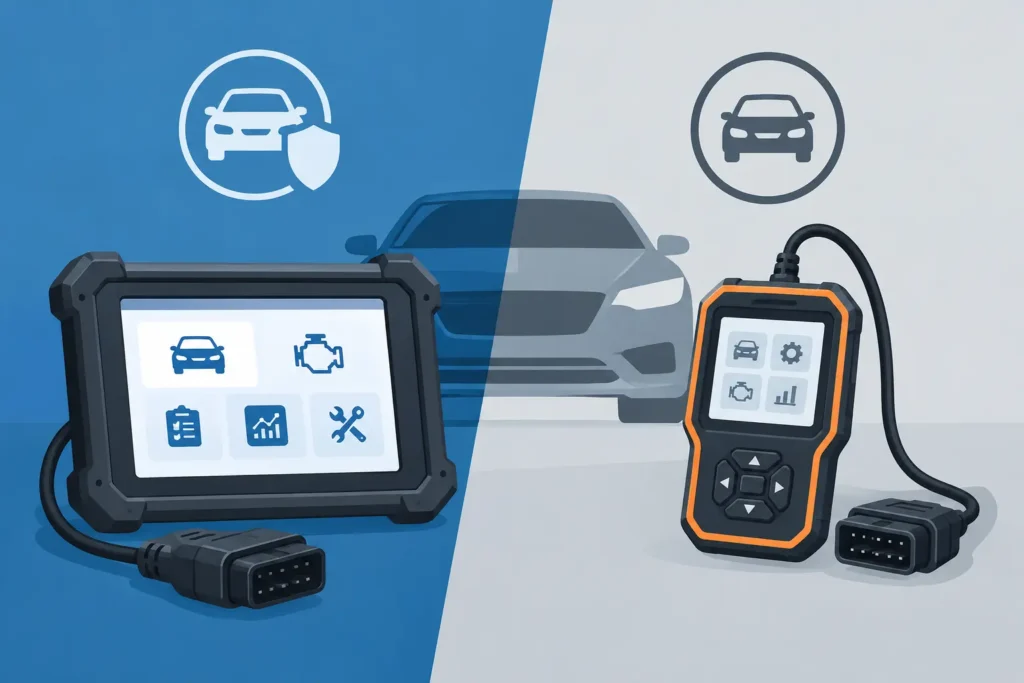
A warning light can make any scanner look useful. But when a vehicle will not start after a lost key, a BCM replacement, or an immobilizer fault, the choice between OEM diagnostics versus a generic scanner can determine whether the real problem is identified or simply given a code number.
Generic scanners have a place. They are useful for reading common engine faults, checking basic live data, and clearing some warning lights. The limitation appears when the issue involves vehicle security, module communication, configuration, or programming. Those systems require more than a universal code reader.
For drivers dealing with a no-start condition, a key that will not program, or a replacement module that is not recognized, proper diagnostics can save time, towing costs, and repeat visits.
What a Generic Scanner Can Actually Do
Most generic scanners communicate through standardized OBD-II protocols. Their main job is to read and clear emissions-related diagnostic trouble codes, often called P-codes. They can commonly display information such as engine RPM, coolant temperature, fuel trims, and oxygen sensor readings.
That makes them practical for many routine concerns. If the check-engine light is on because of a loose fuel cap, an ignition misfire, or an emissions sensor fault, a generic scanner can give a technician a useful starting point. Better aftermarket units may also access some manufacturer-specific systems, depending on the vehicle.
The problem is that access is not the same as control. A scanner may show a code from the body control module, for example, without displaying the complete fault path, module status, security data, or guided test needed to repair it. It may identify a communication fault but not tell you which module is refusing authorization and why.
Clearing a code also does not correct the failure that created it. When a security or module-related issue is present, the code often returns immediately because the underlying configuration, synchronization, wiring, or authorization issue remains unresolved.
OEM Diagnostics Versus a Generic Scanner: The Key Difference
OEM diagnostic systems are designed around the way a specific manufacturer builds, communicates with, and repairs its vehicles. They can access deeper manufacturer data, run system tests, retrieve enhanced fault codes, and perform supported programming functions that a generic scanner usually cannot reach.
This matters because modern vehicles are made up of modules that must agree with one another. The ECU manages engine operation. The BCM can control functions such as locks, lighting, remote access, and vehicle configuration. The TCM manages transmission operation. The immobilizer system verifies that an authorized key is present before allowing the vehicle to start.
A fault in one area can affect another. A vehicle may have a good battery and a working starter but still refuse to start because the immobilizer does not recognize the key or because a replacement ECU has not been matched to the vehicle. A generic scanner may report a vague communication or security code. OEM-level diagnostics can provide the information needed to test the authorization path and determine what must be programmed, repaired, or synchronized.
OEM-level access can also support functions such as key learning, module coding, configuration backup, VIN writing where supported, actuator testing, relearns, and calibration procedures. The exact functions depend on the make, model, year, installed modules, and the service authorization required by the manufacturer.
There is an important distinction here. “OEM-level” does not always mean the exact factory tool used at a dealership. Professional aftermarket platforms can offer extensive manufacturer coverage and guided functions. For the customer, the practical question is whether the technician has the correct equipment, current software, security access, and experience for that vehicle and fault.
Why This Matters for Keys, Immobilizers, and No-Start Problems
Vehicle keys are no longer just cut pieces of metal. Many contain transponder chips, remote electronics, or proximity technology that must be recognized by the vehicle. When that recognition fails, the symptom may look simple: the doors unlock, but the engine will not start.
The cause can be less simple. The key may be incorrectly programmed. The immobilizer may have a stored fault. The antenna ring or smart-key receiver may not be communicating. A weak vehicle battery can create low-voltage module errors. In some cases, a previous repair or replacement module may have left the vehicle out of synchronization.
A generic scanner might show an engine code or no useful information at all. OEM diagnostics can access the relevant body, security, and powertrain modules to verify whether the vehicle sees the key, whether it grants start authorization, and whether another module is preventing the process.
That level of testing prevents guesswork. Replacing a key before confirming the vehicle’s security status, or replacing a module before checking configuration and communication, can turn a repair into an unnecessary expense.
Module Replacement Requires More Than Installation
A replacement ECU, BCM, or TCM is not always ready to work the moment it is installed. Many modules are tied to the vehicle identification number, option configuration, anti-theft system, or other control units. They may need coding, adaptation, or synchronization before the vehicle will operate normally.
For example, a used BCM may physically fit and still cause problems with locks, lights, remote functions, or starting authorization. A replacement ECU may require matching to the immobilizer. A TCM may need a setup procedure or relearn after installation. These are not repairs that can be completed reliably by clearing codes alone.
Professional programming also starts with verification. Before writing data to a module, the technician should confirm battery voltage stability, module compatibility, network communication, and the actual reason the original module failed. Programming the wrong module or interrupting a procedure can create additional issues.
Some manufacturers restrict certain programming and security functions behind online authorization. In those cases, the correct answer may involve dealer access or a specialized approved process. A capable technician should be clear about that rather than promising that every vehicle can be programmed with one universal tool.
When a Generic Scanner Is Enough
Not every issue requires advanced OEM diagnostics. If you want to check a basic engine code, monitor common engine data, or confirm whether a warning light has returned after a simple repair, a quality generic scanner can be completely reasonable.
It becomes less suitable when the vehicle has a security warning, an immobilizer issue, a lost-all-keys situation, multiple module communication codes, or a replacement control unit. The same is true when the vehicle starts intermittently, displays “key not detected,” enters reduced-power mode without a clear engine fault, or has electronic functions that stopped working after battery failure or module work.
Think of a generic scanner as a broad screening tool. It can identify many common concerns. OEM-level equipment is the deeper diagnostic approach when the fault sits behind manufacturer-specific software, security systems, or module configuration.
The Benefit of Mobile OEM-Level Service
A disabled vehicle often cannot be driven to a shop, and towing it adds delay before anyone has even identified the fault. Mobile diagnostic and programming service brings the necessary equipment to the vehicle, which is especially valuable for no-starts, key failures, and module matching work.
For Greater Montreal drivers, Car Kez can assess the vehicle where it is parked, test the relevant electronic systems, and perform supported key or module programming on site. That approach is not about replacing every dealership service. It is about resolving the right problems efficiently when access, starting, and electronic authorization are keeping you off the road.
If your vehicle has a simple check-engine light, a generic scanner may provide the answer you need. If the problem involves a key, immobilizer, ECU, BCM, TCM, or a vehicle that will not authorize a start, ask for diagnostics that can see beyond a basic code and point to the repair that will get you back on the road.