
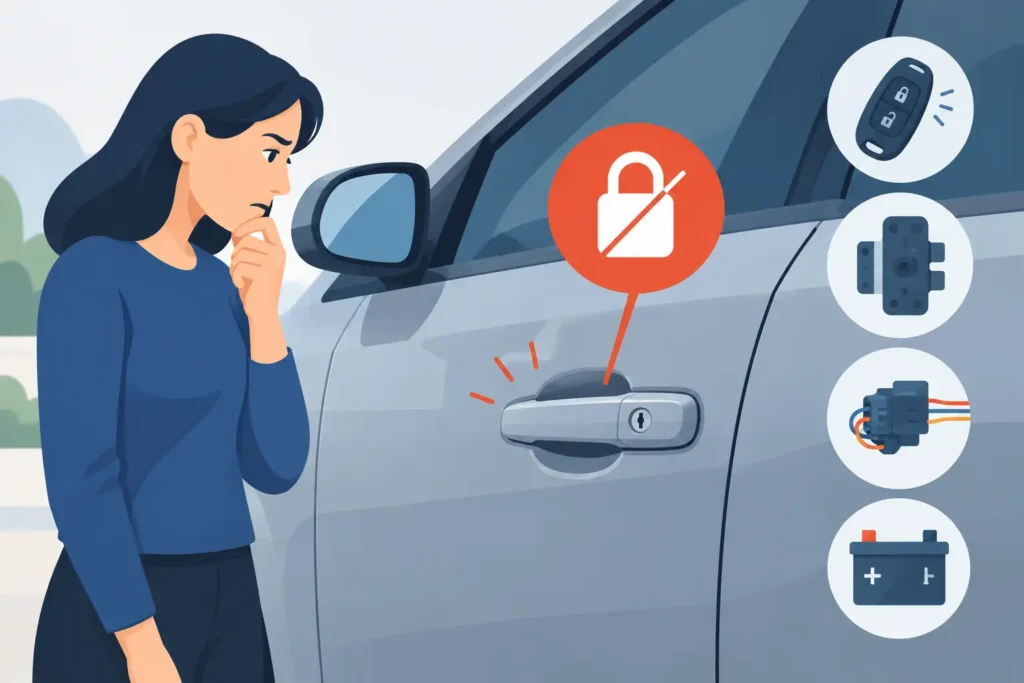
A car door lock not working is more than a small annoyance when you are heading to work, loading children into the vehicle, or parked somewhere unfamiliar. The symptom can come from a simple key fob battery, but it can also point to a failing door actuator, damaged wiring, a seized lock cylinder, or an electronic issue in the Body Control Module (BCM). The right fix depends on what the lock does – and what it does not do.
Before forcing the key, repeatedly pressing the remote, or removing a door panel, narrow down the failure. A few quick observations can prevent damage and help a mobile automotive specialist arrive prepared with the right diagnostic equipment and parts.
What a Car Door Lock Not Working Can Mean
Modern vehicle locks combine mechanical hardware with electronic controls. Your physical key may turn a lock cylinder, while the key fob sends a command to the BCM, which then powers the actuator inside each door. Because several systems work together, one failed door behaves differently from a vehicle where every door has stopped responding.
If only one door will not open or lock electronically, the problem is usually local to that door. A worn actuator, broken wire in the door jamb, damaged linkage, or frozen mechanism is more likely than a vehicle-wide module issue.
If all doors fail at the same time, start with the key fob battery and the vehicle battery. A blown fuse, electrical supply issue, receiver problem, or BCM fault may also be involved. On vehicles with smart keys, weak vehicle voltage can create inconsistent access behavior long before the vehicle becomes a complete no-start.
The details matter. Does the door make a clicking sound? Does the lock pin move slightly and stop? Does the physical key work? Do the interior lock controls respond? These signs point a technician toward the correct system.
Start With the Simple Checks
A dead coin-cell battery is one of the most common reasons a remote suddenly stops operating the locks. If you have a spare fob, test it. If the spare works normally, replace the battery in the original fob and inspect its buttons and case for damage or moisture.
Next, try the interior power-lock switch. If the interior switch operates all doors but the remote does not, the issue is likely with the fob, its programming, or the vehicle’s remote receiver. If neither the remote nor interior switch works, check whether other electrical functions are acting strangely. Dim lights, slow cranking, warning messages, and intermittent electronics can all indicate a weak 12-volt battery.
For one affected door, listen closely while pressing the lock button. A faint click, repeated clicking, or a sluggish movement often suggests a worn actuator motor or binding latch assembly. No sound at all can indicate an electrical connection issue, a broken wire, or a failed actuator.
Do not assume a physical key will always solve an electronic lock problem. On many vehicles, the mechanical cylinder is rarely used and may be stiff from dirt, corrosion, or lack of use. Forcing the key can bend it, damage the cylinder, or leave you with a larger repair.
Common Causes Inside a Single Door
Failed door lock actuator
The actuator is the small electric motor and gear assembly that moves the lock mechanism. It is a frequent failure point, especially on higher-mileage vehicles. You may hear it trying to work without seeing the lock move, or the door may work intermittently before failing completely.
An actuator replacement usually requires removing the interior door panel and accessing the latch assembly. The job can be straightforward on some vehicles and time-consuming on others, particularly when trim clips, vapor barriers, cables, and side-impact components are involved. Replacing an actuator with the correct part matters because poor-quality units can create repeat failures.
Broken wiring in the door jamb
Every time a door opens and closes, its wiring harness bends inside the rubber boot between the door and body. Over time, wires can crack internally. This often causes an intermittent failure: the lock works when the door is in one position but not another, or other functions such as the window, speaker, mirror, or courtesy light fail too.
A proper repair requires testing the circuit rather than guessing. Splicing the wrong wire or using an unreliable connector can create new electrical problems, especially on vehicles that monitor door status through the BCM.
Binding latch, linkage, or lock cylinder
Cold weather, moisture, road salt, internal corrosion, and worn linkage can keep a latch from moving freely. This is especially relevant during Greater Montreal winters, when moisture can freeze around the mechanism. If the physical key turns but the door does not release, the issue may be mechanical rather than electronic.
A frozen lock should be warmed carefully with an appropriate product or by moving the vehicle to a warmer location when possible. Open flames, boiling water, and excessive force are poor choices. They can damage paint, weather seals, electronic components, or the lock itself.
When Every Door Lock Stops Responding
A vehicle-wide failure deserves more attention because the cause may sit outside the doors. Begin with the vehicle battery condition. Even if the dash lights come on, voltage can be too low for modules and actuators to operate consistently under load.
Check relevant fuses only if you can identify them correctly from the owner’s manual. Replacing a blown fuse without finding the reason it failed can lead to another failure or damage. If a replacement fuse blows immediately, stop there and have the circuit tested.
The BCM is another possible cause. This module manages functions such as power locks, interior lighting, alarm behavior, keyless entry, and door-ajar signals on many vehicles. A BCM problem may appear alongside unusual symptoms: locks cycling by themselves, a remote that works only intermittently, warning lights, interior lights that stay on, or doors that the vehicle does not recognize as closed.
Module diagnosis is not a matter of plugging in a generic code reader and replacing the first part named in a fault code. A specialist may need to inspect live data, verify power and ground, test communication networks, and determine whether a replacement BCM requires programming, configuration, or immobilizer synchronization.
Key Fob Programming and Smart-Key Problems
A key fob can have a good battery and still fail to communicate with the vehicle. Water damage, worn buttons, circuit-board damage, and lost programming are all possible. In some cases, the fob can still start the vehicle through a backup transponder procedure but cannot operate the doors remotely.
Smart-key systems add another layer. The vehicle may use proximity antennas, a smart-key control unit, and encrypted communication between the key and immobilizer system. After a module replacement, battery issue, collision repair, or attempted aftermarket installation, programming may need to be verified with OEM-level diagnostic tools.
Avoid buying a random replacement fob and expecting it to work immediately. The part number, frequency, chip type, and programming procedure must match the vehicle. Some keys can be programmed quickly, while others require security access, online authorization, or module adaptation.
When to Call a Mobile Automotive Specialist
Call for professional help when the door is stuck closed, the physical key will not turn, locks fail across the vehicle, or a lock problem is paired with a no-start, immobilizer warning, or BCM-related symptoms. These situations can become security issues quickly, and forcing access can damage the door, glass, weather stripping, or electronics.
A mobile specialist can assess the issue where the vehicle is parked, test keys and remotes, gain non-destructive entry when needed, and diagnose electronic control systems without requiring a tow. For complex access and programming faults in Greater Montreal, Car Kez brings automotive locksmith capability and OEM-grade diagnostics directly to the vehicle.
If the door still opens but the lock has become intermittent, schedule service before it fails completely. An actuator that clicks today may leave the door stuck tomorrow, usually at the least convenient time.