You usually find out you need a car key programming service at the worst possible moment – when the car will not start, the remote stops responding, or a replacement key turns in the ignition but does nothing. At that point, the issue is rarely just the key blade. Modern vehicles rely on communication between the key, immobilizer, and control modules, and when that communication fails, the car stays put.
What a car key programming service actually does
A proper car key programming service does more than copy a key. It pairs a new or existing key to the vehicle so the immobilizer recognizes it and allows the engine to start. On many models, it also programs remote lock and unlock functions, trunk access, push-button start authorization, and smart key proximity features.
That matters because modern keys are part of the vehicle security system. Inside the fob or key head, there is often a transponder chip that must be matched to the car’s system. If the chip is not programmed correctly, the vehicle may crank and die, fail to crank at all, or display a security warning on the dash.
This is where many drivers get mixed answers. A hardware store may be able to cut the metal blade. A general locksmith may duplicate some basic keys. But when the vehicle requires immobilizer data, PIN access, EEPROM work, or module synchronization, the job moves into diagnostic territory.
When you need car key programming service
Lost keys are the obvious reason, but they are not the only one. Drivers often need programming after buying a spare key, replacing a damaged fob, or dealing with a key that suddenly stops being recognized. In other cases, the key is fine and the real problem is elsewhere in the system.
If a vehicle has had an ECU, BCM, or ignition-related module replaced, the new part may need to be matched to the immobilizer before the car will start. The same goes for some used module installations. Even when the replacement part is good, it may not communicate properly until the programming is completed and the system is relearned.
There are also cases where customers assume the battery in the key fob is the whole problem. Sometimes it is. Sometimes a fresh battery restores remote functions but not starting authorization. That difference is important because remote locking and immobilizer approval are often separate functions.
Why modern vehicles make key issues more complicated
Older mechanical keys were straightforward. If the cut matched, the key worked. Newer vehicles add layers of electronic security designed to reduce theft, but that also means more failure points and more specialized service when something goes wrong.
A smart key system may involve the key itself, the push-to-start button, antenna modules, the body control module, and the immobilizer logic stored in one or more control units. If one part loses sync, replacing the fob alone may not solve the problem. The key has to be programmed correctly, and the vehicle may need a diagnostic scan to identify whether the issue starts with the key, the receiver, or a related module.
That is why dealership-only assumptions are not always accurate. Some programming jobs do require advanced OEM-level tools and vehicle-specific procedures, but they do not always require towing the vehicle to a shop. A capable mobile specialist can often perform the same level of programming and diagnostics on-site.
Mobile car key programming service vs. the dealership
For many drivers, the biggest difference is downtime. If the car will not start, getting it to a dealership usually means arranging a tow, waiting for an opening, and then waiting again for programming. That process can stretch from hours into days, especially when parts, key codes, or diagnostic steps are involved.
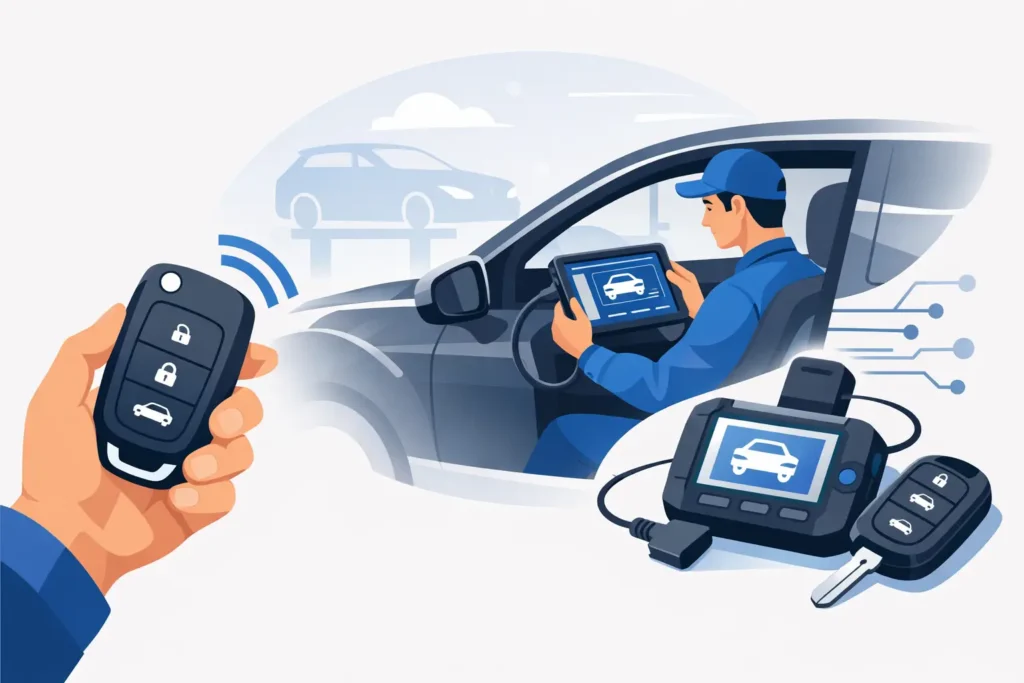
A mobile car key programming service comes to the vehicle. That changes the experience immediately. You do not have to coordinate transport for a disabled car, and the technician can assess the vehicle in the exact condition it failed. That matters because intermittent key recognition, no-start conditions, and module communication faults can be easier to verify before the vehicle is moved.
The trade-off is that not every provider offers the same depth of service. Some mobile locksmiths handle only basic key duplication and simple transponder pairing. More complex jobs, especially those involving ECU, BCM, or TCM synchronization, require stronger diagnostic capability and OEM-grade equipment. That is the line customers should pay attention to.
What a qualified technician checks first
The best service calls do not start by guessing. They start by confirming the symptom. Is the key not turning? Is the fob not locking the doors? Does the dashboard say no key detected? Does the engine crank but fail to start because the immobilizer is active?
From there, the technician typically checks battery condition in the vehicle and the fob, scans the vehicle for fault codes, verifies module communication, and confirms whether the issue is key-related or module-related. On some vehicles, all keys may need to be present during programming. On others, lost-key procedures can erase missing keys from the system for security.
This diagnostic step is what separates a quick fix from a repeat problem. If a key is programmed successfully but the BCM has an underlying communication fault, the customer may be back in the same situation soon after. Accurate diagnosis saves time, avoids unnecessary parts, and gets the repair done correctly the first time.
Common problems a car key programming service can solve
The most common job is programming a new transponder or smart key after a key is lost, broken, or stolen. But a capable provider can also help when the key exists and the vehicle still does not respond properly.
That includes cases where the immobilizer blocks starting, a replacement ECU or BCM needs to be matched, or a used module has to be adapted to the vehicle. It can also include remote relearn procedures, proximity key pairing, and recovering function after all keys have been lost. In more advanced situations, the issue may involve reading stored data, correcting configuration mismatches, or syncing multiple control units so the vehicle can recognize the authorized key again.
For the customer, the key point is simple: not every no-start with a key symbol on the dash means you need a new key. Sometimes you need programming. Sometimes you need module matching. Sometimes you need both.
How to choose the right car key programming service
Look for a provider that can explain the difference between key cutting, transponder programming, and module-level diagnostics. Those are not interchangeable services. If a company only talks about duplicating keys, it may not be equipped for immobilizer or control module issues.
Ask whether the technician can work on-site, whether they support smart keys and proximity systems, and whether they use OEM-level diagnostic tools. If your vehicle has already had a control module replaced or is showing communication-related faults, that last point matters a lot.
Response time matters too, especially in lockout or no-start situations. A service that combines emergency mobile support with real programming capability offers a practical advantage over sending one company for access and another for diagnostics. In Greater Montreal, Car Kez is built around exactly that need: mobile key solutions paired with advanced on-site programming and electronic diagnosis.
What to expect during the appointment
In most cases, the technician will confirm vehicle identification, inspect the available keys or fobs, and test current symptoms before programming begins. Depending on the vehicle, they may connect directly to the onboard diagnostic system, retrieve security access, and perform a guided programming or relearn procedure.
Some jobs are quick. Others take longer because the system must be reset, multiple modules must be synchronized, or the vehicle has aftermarket complications. Water-damaged keys, weak vehicle batteries, and prior unsuccessful programming attempts can all add time. A good technician will explain that upfront instead of forcing a one-size-fits-all answer.
The goal is not just to make the key respond once. It is to restore consistent starting, locking, and security function so you can get back on the road with confidence.
When your vehicle depends on electronic authorization to start, the right fix is rarely guesswork. The fastest path is usually the one that combines key expertise, real diagnostics, and mobile service at the vehicle’s location.
Pingback: Smart Key Not Detected Fix: What to Check - Car Kez
Pingback: ECU Programming for Used Module Issues - Car Kez
Pingback: How to Replace Lost Car Key Fast - Car Kez
Pingback: Why Does My Car Say No Key? Causes and Fixes - Car Kez
Pingback: Échec appairage antidémarrage: Why Cars Won’t Start - Car Kez
Pingback: How to Identify a Faulty BCM Before It Strands You - Car Kez
Pingback: How to Reset Your Automotive Remote Control - Car Kez