
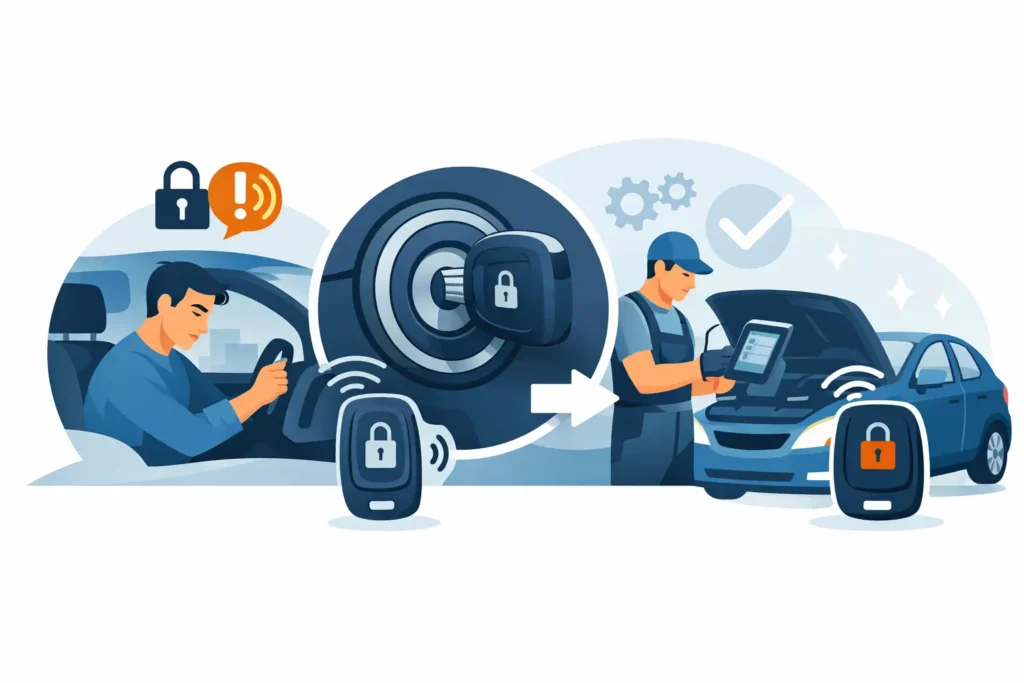
You turn the key or press the start button, the dash lights up, and then nothing useful happens. Maybe the engine cranks and dies. Maybe it does not crank at all. Maybe a security light stays on or flashes. If you are dealing with a car wont start immobilizer problem, the issue is often not the battery or starter – it is the vehicle refusing to authorize the start.
That distinction matters. An immobilizer problem can look like a dead car, but the real fault may be in the key chip, antenna ring, ECU communication, BCM data, or module programming. This is why some no-start situations waste hours on the wrong repairs before the actual cause is found.
What a car wont start immobilizer problem actually means
Modern vehicles use an anti-theft system that checks whether the key, transponder, or smart fob is recognized. When you try to start the car, the immobilizer system reads coded data and compares it with what is stored in the vehicle. If the code is missing, corrupted, or not matched correctly, the system blocks fuel delivery, ignition, starter activation, or a combination of all three.
In practical terms, the car is doing exactly what it was designed to do – prevent unauthorized starting. The problem is that authorized owners can get locked out by the system too.
This can happen after a lost key situation, a weak or damaged key, a battery issue in the smart fob, water exposure, an ECU or BCM replacement, or a failed synchronization between modules. On some vehicles, even a simple battery disconnect can trigger a fault if the system was already unstable.
Signs the immobilizer is the reason your car will not start
The clearest clue is the security indicator. If it stays on, flashes rapidly, or behaves differently than normal during start-up, that points toward authorization failure. Another common sign is when the engine starts for one or two seconds and immediately shuts off.
You may also notice that one key works and another does not, or that the push-button start says no key detected even when the fob is inside the vehicle. In some cases, the remote functions still work but the engine will not start. That is because locking and unlocking can be separate from the immobilizer handshake.
A true immobilizer fault can also be stored as a communication or key authorization code inside the ECU, BCM, or related modules. Without proper diagnostic equipment, these faults are easy to miss or misread.
Common causes behind immobilizer no-start issues
Faulty or unprogrammed key
This is one of the most common causes. A transponder chip inside the key may be damaged, missing, or no longer correctly programmed to the vehicle. With smart keys, internal failure or fob battery issues can add another layer of confusion.
A copied key can also be part of the problem. Basic duplication may cut the blade correctly but fail to match the transponder data well enough for reliable starting.
Failed antenna ring or key reader
Many vehicles use an antenna coil around the ignition or a proximity reader for smart key systems. If that component cannot read the transponder, the car treats the key like it does not belong there. The result looks like a key problem even when the key is fine.
ECU, BCM, or immobilizer module mismatch
This is where things get more technical. If one of the vehicle’s control modules has been replaced, cloned badly, or updated incorrectly, the security data may no longer match across the system. The key can be valid, but the car still refuses to start because the modules are not in sync.
This is especially common after used module installation, collision repair, flood damage, or attempted programming by a shop without OEM-level capability.
Wiring, voltage, or battery-related faults
Low system voltage causes strange behavior in modern cars. An immobilizer may fail to communicate properly if battery voltage drops too far during start-up. Loose grounds, damaged wiring, blown fuses, or corroded connectors can also interrupt the signal path between the key reader and the control modules.
This is why replacing a key is not always the answer. Sometimes the key is only the messenger.
What you can check before calling for help
A few simple checks are worth doing first, especially if you are stranded. Try a spare key if you have one. If the spare starts the car, the original key or fob is likely the issue. If you use a smart key, replace the fob battery if it is weak or old.
Next, look at the vehicle battery condition. If the dash is dim, the click is weak, or the electronics are acting erratically, low voltage may be part of the problem. A jump start can sometimes restore enough power for the immobilizer system to communicate correctly, though not always.
You should also pay attention to the security light behavior and any message on the dash such as key not detected, immobilizer active, or start disabled. That information helps narrow the fault quickly.
What usually does not help is random parts replacement. Swapping batteries, starters, or ignition components without confirming the cause can add cost without moving the repair forward.
Why immobilizer diagnosis often needs specialist tools
An immobilizer no-start is not just a locksmith problem and not just a mechanic problem. It sits in the middle of key security, electronics, and module programming. That is why generic code readers often fall short.
A proper diagnosis may require reading immobilizer status data, checking whether the ECU is receiving a valid start authorization, testing BCM communication, verifying transponder recognition, and confirming whether modules are matched correctly. On many vehicles, the fault is not visible unless you can access manufacturer-level systems and live data.
This is also why towing a car to a general shop does not always save time. If they can confirm only that the car will not start but cannot complete programming or module matching, you still end up needing a specialist afterward.
When the problem is bigger than the key
After ECU or BCM replacement
If your no-start began after replacing an ECU, BCM, ignition switch, or push-start module, the issue may be configuration rather than failure. These components often need to be paired to the vehicle and to each other. Installing a used module without proper setup can leave the immobilizer active.
After all keys were lost
When no working key remains, the job usually involves more than cutting a new blade. The vehicle may need key generation, transponder programming, immobilizer registration, and sometimes module access procedures that vary by make and model.
Intermittent no-start problems
These are some of the toughest cases. If the car starts sometimes and blocks starting other times, the cause may be a weak transponder signal, unstable reader, failing module, or voltage drop. Intermittent faults require careful testing because the system can appear normal once the vehicle finally starts.
The advantage of mobile immobilizer service
For drivers dealing with a car wont start immobilizer problem, convenience matters almost as much as the repair itself. A vehicle that will not authorize a start often cannot be moved, and towing adds cost, delay, and scheduling headaches.
Mobile service changes that equation. Instead of transporting a disabled vehicle, the diagnostics and programming come to you. That means on-site key testing, transponder programming, module scanning, and in many cases ECU, BCM, or immobilizer synchronization where the vehicle is parked.
For customers in urgent situations, that practical difference is huge. You are not just looking for someone who can cut a key. You need someone who can confirm whether the fault is the key, the reader, the module data, or the communication path and then carry out the fix with the right equipment. That is the type of field work Car Kez is built for.
How the right repair depends on the actual fault
There is no universal immobilizer reset that solves every no-start. Sometimes the answer is straightforward, like replacing and programming a failed key. Sometimes the fix is electrical, such as restoring proper voltage or repairing a wiring fault.
And sometimes the job is deeper. Module replacement may need coding and matching. Smart key systems may need re-registration. Security data may need to be corrected after a failed programming attempt. The fastest path is accurate diagnosis first, because that tells you whether the problem is simple, electronic, or software-related.
If your car shows signs of an immobilizer lockout, the best move is to treat it like a security authorization problem, not just a basic no-start. That shift in approach usually saves time, avoids guesswork, and gets you back on the road with the repair actually finished.
Pingback: ECU Programming for Used Module Issues - Car Kez
Pingback: TCM Programming After Replacement Explained - Car Kez
Pingback: How to Locate an Auto Electrical Fault Safely - Car Kez
Pingback: Why a Car Cranks but Does Not Start and What to Check - Car Kez
Pingback: BCM Coding Process Guide for Vehicle Owners - Car Kez
Pingback: ECU reconditionné ou neuf: Which Is Right? - Car Kez
Pingback: How to Reset Immobilizer System Without Guesswork - Car Kez
Pingback: Roadside Locksmith Versus Towing – Which One? - Car Kez
Pingback: Does ECU Programming Affect Your Warranty? - Car Kez